Why Your Managers Believe the Right Things but Do Not Change
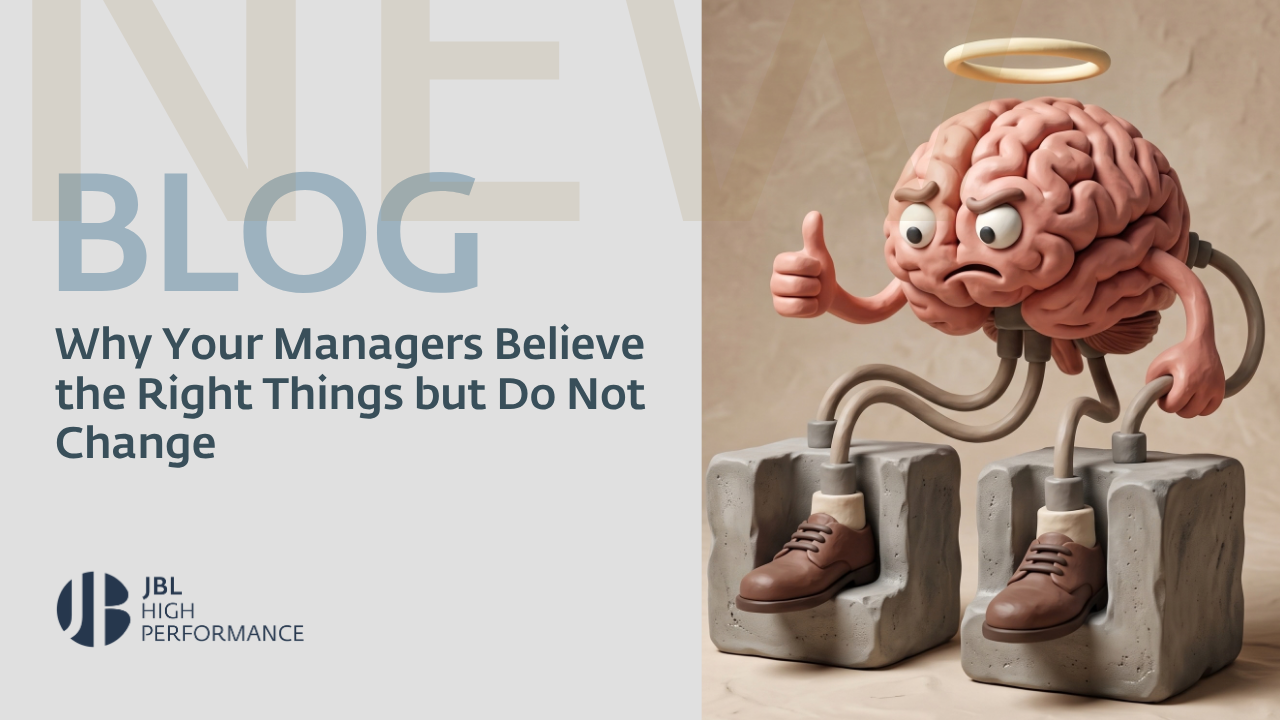
Most leadership programmes teach the wrong thing entirely
If your leaders are coming back from development programmes and reverting to the same patterns within a fortnight, the problem is not the programme content. Most leadership development fails because it is solving the wrong problem.
Organisations spend tens of billions annually on leadership development. Yet 77% of companies still lack ready successors for key positions, and employee engagement remains stubbornly low across most sectors.
Walk into any leadership programme and you will find the same pattern: frameworks for decision-making, models for communication, tools for delegation, techniques for motivation. All focused on what leaders should do differently.
Behaviour change without belief change is performance. It does not last.
The Surface-Level Solution
Traditional leadership development operates on a flawed assumption: that leaders fail because they do not know what to do. So we teach them the "right" behaviours. Scripts for difficult conversations. Templates for strategic thinking. Checklists for team management.
The result is leaders who can perform the right behaviours in a training room and revert to old patterns the moment pressure lands. We changed their toolkit without changing their mindset.
You cannot sustain new behaviours with old beliefs.
The Hidden Operating System
Every leader operates from a set of core beliefs about what leadership means. These beliefs, often unconscious, drive every decision, every interaction, every response to pressure.
Consider these common leadership beliefs:
- "Good leaders have all the answers"
- "Showing uncertainty undermines authority"
- "My job is to solve problems, not create them"
- "If I'm not busy, I'm not adding value"
- "Strong leaders don't need help"
These beliefs feel true because they have been reinforced by years of experience, cultural messaging, and organisational reward systems. They are also the reason leadership development fails.
There is a related pattern worth naming. Most experienced managers lean heavily on the approaches they know work. They maintain patterns and routines because those routines produce expected results. That reliance is also limiting. It can prevent the kind of fresh thinking that a different approach might unlock, including better results than the old method ever delivered. The same dynamic applies to beliefs: familiarity feels like safety, even when it is quietly capping performance.
The Behaviour-Belief Disconnect
Here is what happens when we focus on behaviours whilst ignoring beliefs:
- The Delegation Paradox: We teach leaders to delegate effectively, but if they believe "good leaders handle important work themselves," they will find reasons why this particular task is too critical to hand over.
- The Feedback Trap: We train leaders to give constructive feedback, but if they believe "conflict damages relationships," they will avoid the conversations that matter most.
- The Strategic Thinking Illusion: We show leaders how to think strategically, but if they believe "being busy proves my worth," they will fill their calendars with tactical work that feels more immediately valuable.
- The Vulnerability Paradox: We encourage authentic leadership, but if they believe "showing weakness invites challenge," they will maintain facades that prevent genuine connection.
Are you the bottleneck?
Take the two-minute assessment and see exactly where work is queueing around you, and what to hand over first.
Why Beliefs Trump Behaviours Every Time
Beliefs are more powerful than behaviours because they operate at the identity level. They answer the question: "What kind of leader am I?"
When there is conflict between a new behaviour and an existing belief, the belief wins. Always. Because changing a belief feels like changing who you are, and that is a deeply uncomfortable place to sit.
This is why leaders can nod enthusiastically in training sessions, practise new techniques in role-plays, and then return to their desks and do exactly what they have always done. It is not resistance. It is self-preservation.
In Amplify we look at this entirely differently.
The Real Work of Leadership Development
Effective leadership development does not start with "What should I do differently?" It starts with "What do I believe about leadership, and is that belief serving me?"
- Surface the Hidden Beliefs: Most leaders have never examined their core assumptions about leadership. They have inherited them from previous bosses, absorbed them from organisational culture, or developed them through trial and error. Making these beliefs conscious is the first step to changing them.
- Challenge the Belief System: Once beliefs are visible, they can be questioned. "Is it true that good leaders always have answers? What evidence supports this? What evidence contradicts it? What would be possible if this were not true?"
- Test New Beliefs: Experiment with new beliefs before jumping to new behaviours. "What if my job as a leader is to ask better questions? What if uncertainty is a sign of intellectual honesty?"
- Align Behaviours with New Beliefs: When a leader truly believes that delegation develops people rather than diminishes their own value, they will find ways to delegate effectively. The behaviour follows the belief.
A Practical Tool for Surfacing What Is Really There
One exercise that works well at this stage is a structure called TRIO, Total Reverse Ideal Outcome. The idea is to ask a leader to imagine the absolute opposite of the outcome they want: a thoroughly terrible version of their team or organisation, described in as much raw detail as possible. What would the kind of organisation they least want to lead actually look like?
It sounds absurd until you try it. The value is that it surfaces things people have not consciously acknowledged. There is room for humour as the ideas emerge, which helps lower the guard. The sharper moment comes when you ask which of those "ridiculous" items are already present in the current organisation. Most leaders go quiet. The exercise has a way of making people more honest with themselves than a direct question ever would.
The broader point is that a willingness to experiment builds the capacity for change, and each subsequent shift becomes less daunting to face. Whether TRIO is the right tool or something else entirely, the question worth sitting with is how many of us will genuinely try something new today rather than reaching for the familiar play.
The Identity Shift
The most profound change happens when someone's identity as a leader fundamentally shifts. When they stop seeing themselves as the person who has to have all the answers (The Village Fisherman) and start seeing themselves as the person who helps others find answers (The Icebreaker Leader). When they stop believing their worth comes from being busy and start believing it comes from being effective.
This is about becoming a different kind of leader, not learning new techniques.
Where is the friction in your team?
The Leadership Friction Finder pinpoints where effort is leaking, so you fix the cause rather than the symptom.
Why Organisations Resist This Approach
Belief-based development is harder to sell because it is harder to measure. You cannot create a competency framework for "examining core assumptions about leadership." You cannot tick a box for "identity transformation complete."
It is also more uncomfortable. Questioning beliefs feels risky. It requires leaders to admit that some of their most fundamental assumptions might be wrong, and to sit with uncertainty whilst they work out what they actually believe.
It is, however, the only approach that creates lasting change.
The Practical Path Forward
If you are designing a development programme or working on your own growth as a leader, start with these questions:
- What do I believe makes a good leader? Write down your immediate responses. These are your operating beliefs.
- Where did these beliefs come from? Previous bosses? Organisational culture? Early career experiences? Understanding the source helps you evaluate the validity.
- Which beliefs serve me well? Some of your leadership beliefs are probably helpful. Keep those.
- Which beliefs limit me? Identify the beliefs that create internal conflict, prevent growth, or lead to behaviours you want to change.
- What would I believe if I were the leader I want to become? This is about consciously choosing beliefs that align with your values and aspirations, not adopting someone else's.
- How can I test these new beliefs safely? Start small. Experiment in low-risk situations before applying them to high-stakes challenges.
When beliefs change, behaviours follow. When behaviours align with beliefs, they become sustainable. When leaders operate from consciously chosen beliefs rather than inherited assumptions, they become more effective, more authentic, and more resilient.
Real growth as a leader is about learning to think like a leader, which means examining the beliefs that drive your behaviour and consciously choosing beliefs that serve your growth and your organisation's success.
What beliefs about leadership have you inherited that might be limiting your effectiveness? Which ones serve you well, and which ones are ready for an upgrade?
If this sounds like your week
Your managers are not the problem. They are where the problem is stuck.
When your last leadership spend was signed off, did anyone go back to those managers' bosses and ask what changed? That question is the JBL Outcome Standard, and it is how I work.
- Find the friction. A short diagnostic that shows which decisions are stalling, and at what level.
- Am I the bottleneck? Ten questions on where your week is actually going.
- How I work with GMs. Six weeks, one hour a week, up to twelve of your managers, scored by their own bosses.
- Beat Burnout, Boost Performance. The book.
- The High Performance Leader podcast.
Managers I work with reclaim around four hours a week, and their bosses score the change 8.75 out of 10. Would it be a crazy idea to find out how we did this? Book a scoping call.
Start this week
Busy all day and still behind?
The Quick-Win Pack is five five-minute fixes for the overloaded leader, each built on a framework I use with paying clients. Every fix runs live on the page and hands you a finished, ready-to-use plan in minutes, with no AI account of your own needed. Just $19, and included free with AMPLIFY and the Six Week Reset.
Get the Quick-Win PackQuestions managers ask about this
Why do managers revert to old behaviours after training?
Managers often revert because training changes behaviours without addressing underlying beliefs. Their core assumptions about leadership remain unchallenged, so under pressure they default to familiar patterns. Sustainable change requires examining and shifting these deep beliefs, not just learning new actions.
How do beliefs affect leadership behaviour change?
Beliefs shape a leader’s identity and guide decisions. When new behaviours conflict with existing beliefs, the beliefs prevail because changing them feels like changing who they are. Lasting behaviour change comes from first making beliefs visible, questioning them, and adopting new beliefs that support new behaviours.
What common leadership beliefs hinder effective delegation?
A common belief is that good leaders must handle important work themselves. This mindset causes leaders to avoid delegating critical tasks, seeing them as too risky to pass on. Changing this belief to view delegation as a way to develop others helps leaders delegate more effectively and sustainably.
Why do leadership programmes focusing on behaviours often fail?
Leadership programmes that focus only on behaviours fail because they ignore the leader’s belief system. Without addressing core assumptions about leadership, leaders can perform new behaviours temporarily but will revert under stress. Effective development starts by identifying and challenging these beliefs before aligning behaviours with new mindsets.
Explore this topic
Hear this discussed on the podcast
Episodes of The High Performance Leader that cover the same ground.

Jimmy Burroughes
FounderFormer British Army officer and corporate GM who has transformed nearly 3,500 managers into leaders across 30+ organisations. Creator of the Simplify to Amplify methodology, author of Beat Burnout, Ignite Performance, and two-time Global Recognition Award winner.
Keep exploring
Want to know where the drag really is?
Before you change anything, get an honest read on the friction slowing your team down. Take a short, free diagnostic and see exactly where the time is going.