Why Your Management Playbook Is Outdated and What Replaces It
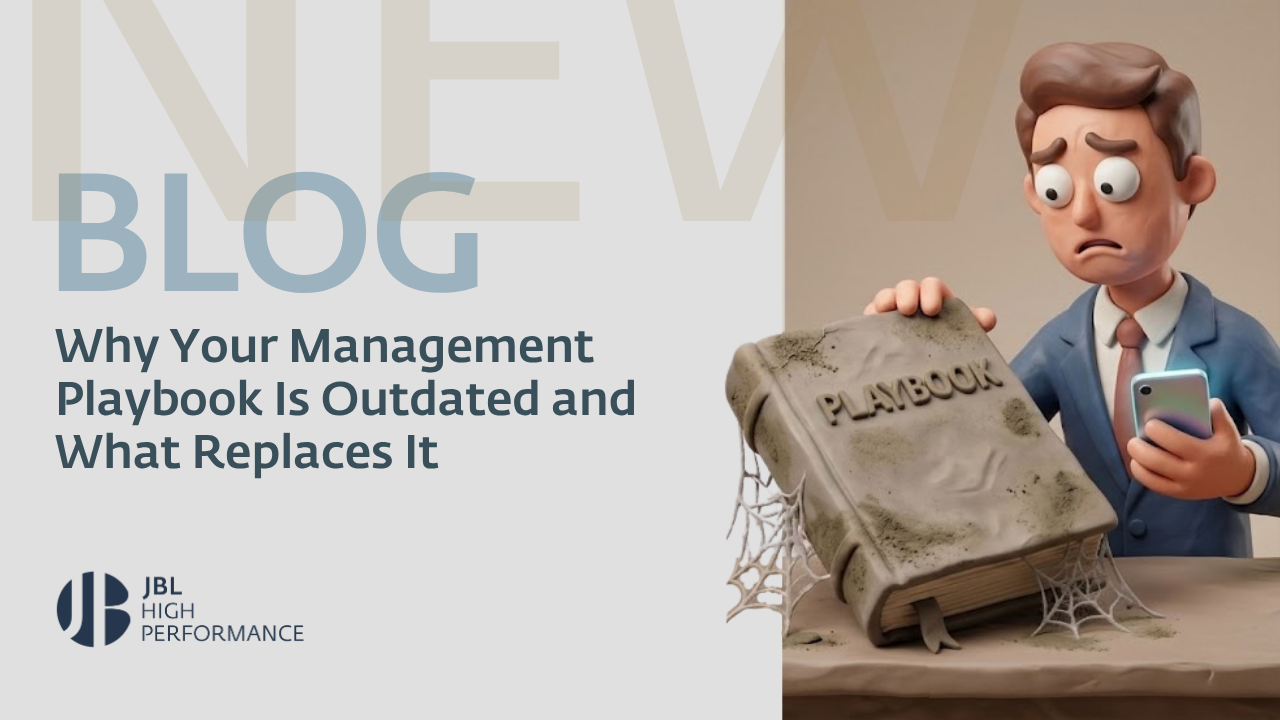
My most valuable leadership lesson came not from a classroom but from the bite of an enormous backpack digging into my shoulders on some godforsaken training exercise in Wales. In the British Army, you learn one thing fast: extra weight is a liability. It gets people hurt. So you become ruthless. You field-strip your kit until only the essentials remain (memories of cutting toothbrushes in half remain). That instinct has never left me.
Twenty years on, I see the same thing playing out in offices, but in reverse. I watch good managers dragging themselves through the week, carrying a metaphorical pack stuffed with rusty tools, outdated beliefs, and habits that should have died a decade ago. They wonder why decisions keep landing on their desk that should have been made two levels down, why their teams look like they have completely checked out, and why they are missing the number even while working harder.
Burning the old playbook raises an obvious, fair question: what do you replace it with? You need a lighter, faster, more effective kit for leading a business that will not slow down. After working with over 3,000 leaders, I have seen what that toolkit looks like. It starts by ruthlessly jettisoning what is holding you back.
The Promotion Trap
The habits that got you promoted are now getting in the way of running the business you are responsible for. When leaders step up, most double down on what worked before: more checklists, extra meetings, tighter control, longer hours. It feels productive because it is familiar. The landscape has changed, though, and you are still following an outdated map.
If you only have a hammer, every problem looks like a nail. Sometimes what you need is a spanner.
The practices that made you successful as an individual contributor become liabilities when you lead leaders:
- Assuming sole decision-making authority
- Fixing every problem yourself
- Being the one with all the answers
These habits feel comfortable because they worked before. Now they are creating bottlenecks, burning you out, and stopping your team from growing. The question is whether you are willing to unpack your backpack and let go.
Emptying the Old Backpack and What to Try Instead
Before you can pack the right gear, you have to ditch the dead weight. Most managers are weighed down by four pieces of obsolete kit.
1. The Annual Performance Review
This is the heaviest, rustiest tool in the bag. It is a corporate séance where managers, armed with vague recollections, attempt to justify a rating decided months ago. The feedback arrives too late to be useful, the process breeds fear, and it reduces a year of human effort to a single box-ticking exercise. It was designed for organisational compliance, not performance improvement. The cost is real: you create a culture of fear around feedback and miss countless opportunities to course-correct in real time.
Instead, focus on 10 to 15 minute meaningful check-ins weekly with each member of your team. We use a format called 3x3x3. This gives you a handle on what your team is doing and lets you steer them in real time without micromanaging.
The 3x3x3 format covers:
- 3 wins you had this week and what impact they made to the team
- 3 things you are prioritising next week and how they will benefit the team
- 3 things you need approved, decided or supported on by me
2. The Illusion of Control
When we feel unstable, the instinct is to grab the wheel tighter. This shows up as endless meetings and approval bottlenecks. Meetings multiply to "stay aligned," but most are poorly disguised status reports that could have been an email. Approval gates are added to "ensure quality," but they create queues, slow down the work, and signal a fundamental lack of trust. It puts a tax on your team's speed and morale.
Two mindsets help here. The first is the realisation that you got where you are through a combination of hard work and battle scars. We have to kiss some professional frogs to find a prince or princess, and the same applies to your team. Let them kiss frogs. Allow this to happen in areas where they can graze their knees, not break their legs. We want battle scars but not permanent disfiguration. If you are in a 3x3x3 catch-up and you know something is not going well for them but that it will give them a great experience, let it flow.
The second is the realisation that giving up control can ease the burden on you and sometimes produce better results than you would have managed alone. L. David Marquet's book Turn the Ship Around centres on the idea that letting 143 sailors think will always outperform relying on one person for everything.
3. The Hero Manager Cape
The hero manager who always swoops in to save the day feels essential. They get a rush from being the one with all the answers, the one who fixes the crisis. But this is one of the most selfish acts in management. Every time you "save" your team, you rob them of a chance to learn. You create dependency, not capability. You become the ceiling on their potential and guarantee your own burnout. Your job is to build a team that does not need rescuing.
Real growth demands a fundamental shift in how you see your role. Think of it as moving from Village Fisherman to Icebreaker Captain.
The Village Fisherman always has the answers, does all the problem-solving, and acts as the team's superhero. This worked when you were responsible for results you delivered yourself. The Icebreaker Captain forges a path through challenges, creating a safe route so the whole team can move forward together. The role is less about having all the answers and more about creating space for good ideas to surface from the team. Moving from "I'll make all the decisions" to "I'll create space for the best ideas" is the shift that changes everything.
Become the Icebreaker leader instead. The best leaders spend their time hunting for friction: the invisible, systemic issues that cause problems in the first place.
The icebreaker is the activity at the start of a networking event or meeting that helps everyone feel at ease. In leadership terms, this means creating psychological safety: helping your team feel safe to speak, act, learn and grow.
An icebreaker ship is also the vessel that sails in front of the flotilla and breaks the ice, removing the icebergs that could tear a hole in the hull or sink one of the ships. Friction hides in handoffs, approval delays, and ambiguous standards. Find it and kill it, and your team sails through clearer water.
A construction firm I worked with was constantly missing project deadlines. The leadership blamed the site managers; the site managers blamed the crews. Everyone was working harder and still falling behind. We went friction hunting.
- Map the Work. Get everyone involved in a process into a room with a whiteboard. Draw the process from start to finish. Map what actually happens, warts and all, not the ideal process from the manual.
- Time the Waits. Look at the gaps between the boxes. This is where the friction lives. How long does it take for a decision to be approved? How long does a request sit in someone's inbox? We found the construction firm was losing three days on every project waiting for a single engineering approval.
- Ask "Why?" Five Times. Once you find a delay, dig for the root cause. Why is there a three-day wait? Because the engineer is overloaded. Why is he overloaded? Because he has to approve things that do not need his expertise. Why? Because the policy has not been updated in ten years. Asking "why" repeatedly moves you from blaming people to fixing the broken system.
4. The "More is More" Mindset
Faced with a problem, the default corporate response is to add something: a new process, a new software tool, a new initiative, a new meeting. Solutions pile up without anything being taken away. This "initiative-itis" adds more weight to an already overburdened pack. The most effective leaders I know are masters of subtraction. Progress comes from removing the friction that slows down the important things.
Are you the bottleneck?
Take the two-minute assessment and see exactly where work is queueing around you, and what to hand over first.
Audit Your Toolkit
If you are slipping back into comfortable old habits, micromanagement, endless checklists, pointless meetings, pause and ask whether you are choosing the right tool for the job or simply the comfortable one. Run a quick leadership inventory:
- What tools or habits are helping you move forward?
- What burdens are holding you back?
- What are you carrying that you no longer need?
Emptying your backpack is often where real effectiveness begins.
The PVC Model: Your Operational Filter
We teach a model called PVC. This is your operational filter for every commitment. Before you invest your focus, energy, or time, run the task, meeting, or project through these three gates. If it fails any one of them, it does not get your attention.
P is for Purpose: The Why
- The Work: Why this? What critical outcome does it serve? What breaks if we simply do not do it? Does it serve the mission or is it a distraction?
- My Involvement: Why me? Is my involvement essential, or am I the default? Am I here to enable a decision or to control an outcome?
V is for Value: The Trade-Off
- The Work: Is this the highest-value activity for the business right now? What are we saying "no" to by doing this? Does this create leverage or is it a one-off task?
- My Involvement: Is this the highest-value use of my time? What is the opportunity cost of my involvement here versus somewhere else? Am I doing £10 work at a £1,000 an hour rate?
C is for Capacity: The Reality Check
- The Team: Does the team have the skills, time, and authority to win? What is missing: a skill gap or a system constraint? Are we setting them up for success or for burnout?
- My Involvement: Do I have the personal bandwidth to do this properly? Will I be fully engaged or a drive-by manager causing chaos? What does saying "yes" to this take my energy away from?
Where is the friction in your team?
The Leadership Friction Finder pinpoints where effort is leaking, so you fix the cause rather than the symptom.
You Cannot Give What You Do Not Have
A disengaged manager will never build an engaged team. Many leaders are running on empty, buried in work that drains them, and then asked to go and inspire their people. It is an impossible task.
Before you can fix your team, fix your own role. Try this simple exercise: the Calendar Audit.
Your calendar is a statement of your priorities. A cluttered calendar means cluttered priorities.
Use this response menu to protect your focus and ensure every meeting is a high-value use of time. We call it the Calendar Defence Menu:
- Need a meeting? Is a live meeting the right tool for this job, or could a call or email be faster?
- No. This does not align with our priorities and has no clear strategic value.
- Not yet. We are not prepared. A meeting now would be a waste of time.
- Need more. I cannot have a useful discussion without more information (for example, purpose, data, agenda).
- Not now. This is important, but it is not the priority right now.
- Not me. I am not the right person to add value here. This should be redirected.
- Noodle. This topic is too important for a quick decision and requires dedicated thinking time.
- Not enough people. A one-to-one does not need a formal meeting slot. Let's have a quick phone call instead.
The job of a modern leader is to make the pack lighter. After working with thousands of leaders, I reckon only about 3 per cent truly get this. The rest keep piling more into their pack and wondering why the journey is so bloody hard.
If this sounds like your week
Your managers are not the problem. They are where the problem is stuck.
When your last leadership spend was signed off, did anyone go back to those managers' bosses and ask what changed? That question is the JBL Outcome Standard, and it is how I work.
- Find the friction. A short diagnostic that shows which decisions are stalling, and at what level.
- Am I the bottleneck? Ten questions on where your week is actually going.
- How I work with GMs. Six weeks, one hour a week, up to twelve of your managers, scored by their own bosses.
- Beat Burnout, Boost Performance. The book.
- The High Performance Leader podcast.
Managers I work with reclaim around four hours a week, and their bosses score the change 8.75 out of 10. Would it be a crazy idea to find out how we did this? Book a scoping call.
Start this week
Busy all day and still behind?
The Quick-Win Pack is five five-minute fixes for the overloaded leader, each built on a framework I use with paying clients. Every fix runs live on the page and hands you a finished, ready-to-use plan in minutes, with no AI account of your own needed. Just $19, and included free with AMPLIFY and the Six Week Reset.
Get the Quick-Win PackQuestions managers ask about this
Why are annual performance reviews ineffective for managing teams?
Annual performance reviews are ineffective because they provide feedback too late to be useful, create fear around feedback, and reduce a year's work to a single box-ticking exercise. They focus on compliance rather than improvement, missing opportunities for real-time course correction. Instead, regular short check-ins offer timely insights and keep teams aligned and motivated.
How can I reduce unnecessary meetings and approval delays?
Cut down on meetings that serve as disguised status reports and replace them with concise email updates. Streamline approval processes by trusting your team to make decisions within their scope. This reduces bottlenecks, speeds up work, and improves morale. Allow your team to learn from mistakes in safe areas instead of controlling every detail yourself.
What are the risks of being a 'hero manager' who fixes all problems?
Being a 'hero manager' creates dependency by rescuing the team instead of letting them solve problems. It limits their development and puts a ceiling on their potential. This behaviour also leads to burnout for the manager. Instead, focus on creating psychological safety so your team feels able to speak up, learn, and grow independently.
How can mapping work processes help improve team performance?
Mapping work processes reveals hidden delays and friction points by showing the actual flow rather than the ideal. Timing waits between steps helps identify bottlenecks, such as approvals causing long delays. Asking 'why' multiple times uncovers root causes, enabling targeted fixes that speed up work and reduce blame, leading to smoother team operations.
Explore this topic
Hear this discussed on the podcast
Episodes of The High Performance Leader that cover the same ground.

Jimmy Burroughes
FounderFormer British Army officer and corporate GM who has transformed nearly 3,500 managers into leaders across 30+ organisations. Creator of the Simplify to Amplify methodology, author of Beat Burnout, Ignite Performance, and two-time Global Recognition Award winner.
Keep exploring
Want to know where the drag really is?
Before you change anything, get an honest read on the friction slowing your team down. Take a short, free diagnostic and see exactly where the time is going.