How to Find the Weak Spots in Your Team Before They Show Up in Results
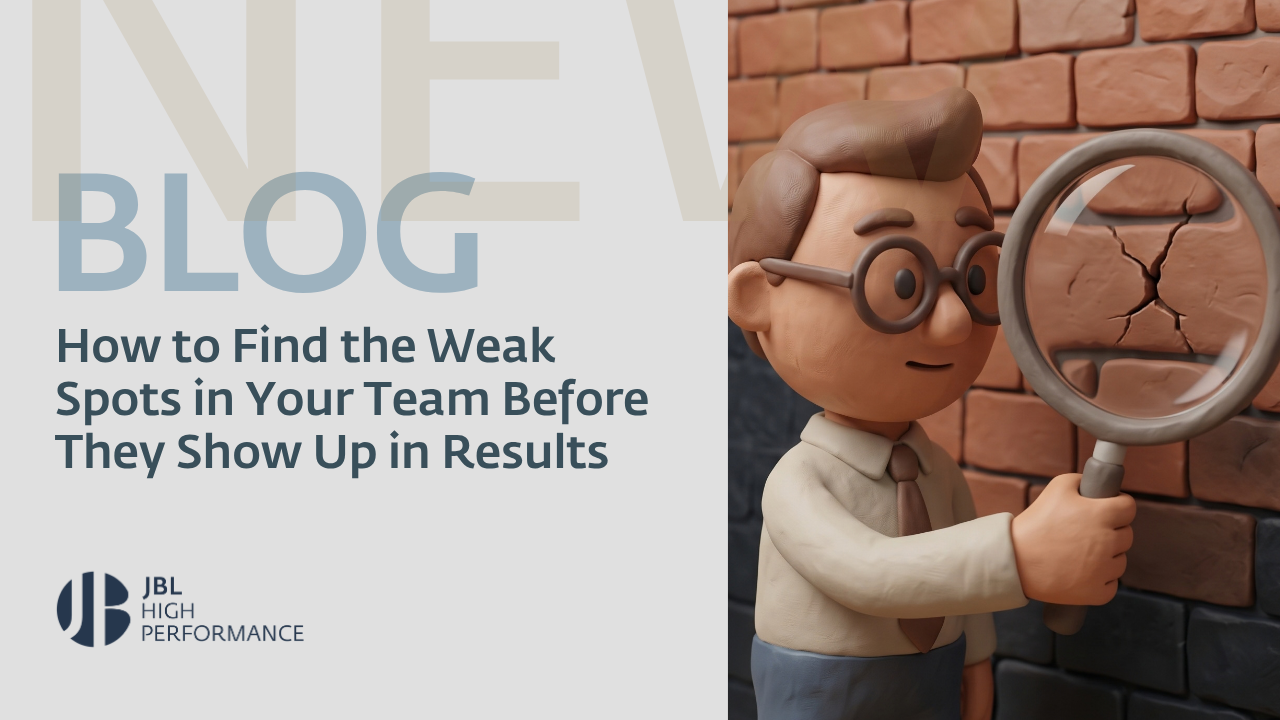
The title is clickbait, and I apologise for that. It came from a conversation with a mentor who used to say, "It's only when the tide goes out that those people swimming naked get found out."
My instructors at Sandhurst talked a lot about leadership being straightforward until one of your soldiers got shot, and then you having to actually lead. The same is true in most of real life. When times are easy, everyone looks like they're coping well. When the tide goes out, those without the rigour to survive, don't.
This week I faced a confronting and unexpected challenge in my personal life that left me feeling powerless, frustrated and angry, with a heap of other counterproductive emotions that threatened to drown me. The familiar mental patterns kicked in: withdrawing, hunkering down, being selfish. "Why is this happening to me? Why now? It's not fair." And so on.
I heard the voice that said this is not how I coach people to cope. So I stopped the pity party, almost immediately, and forced myself to ask: how would I coach myself through this?
I used a model that focuses on moving through crisis.
Editor's note: given my love of diving and the tide reference in the first paragraph, I couldn't help but "sea" the irony in this SALT model.
The SALT Model for Moving Through Crisis
Stop
Stop daydreaming, stop crying, stop panicking. Be present in the moment. Research has shown that basic mindfulness allows the pre-frontal cortex (the smart part of your brain) to work more effectively, and coincides with a drop in amygdaloidal activity (the stress centre of your brain). Concentrating on your immediate surroundings, rather than the bad news or the argument, brings you into the present.
Attention Outwards
Once you are aware of your surroundings, direct your attention at the wider situation. Say you have just been told you are going to be made redundant. Instead of spiralling into "how am I going to pay my bills, feed my family," try to analyse the situation. Ask yourself these questions, or your own versions of them.
- What is actually going on here?
- How did this happen?
- Who else has been impacted by this?
- How can I help them?
- How do I want to be perceived in this moment?
- Who would deal well with this?
- What are my next three steps?
The team at Herrmann International know from surveying over 2 million people that by engaging the left brain with these questions, we bring our emotion centres under more rational control, which helps us think more clearly. David Rock, in his book Quiet Leadership, describes how rational questioning during coaching helps reach insight by keeping attention off the problem itself.
Finding others who may be worse off, and then helping them, produces what I'd call the "giving emotion," which sets off dopamine secretions that make us feel better too.
Look for Something to Be Grateful For
This can be hard, but reframing and offering gratitude are two powerful tools for combatting strong emotion, especially negative ones. In my own situation I had to admit things could have been worse, and I was grateful for the time I had to process events before being flung fully into them, and for that beautiful sunset in Medellín. The fact I was in Medellín at all.
Finding gratitude is a powerful way of becoming more calm, and it carries a range of other significant benefits described by Rob Emmons in his book Thanks!: How Practising Gratitude Can Make You Happier.
Take Selfless Action
Mark Manson, in The Subtle Art of Not Giving a Fu*k, argues that action is driven by inspiration and then motivation. He also points out that this is not linear but cyclical: doing something produces a sense of achievement, that achievement feels good, and that feeling motivates you to do more. So it starts.
In a crisis, or when emotion is running high, inspiration and motivation are often absent. In my moment of self-pity I switched on a film with a beer. About as low-action as it gets.
The way through is selfless action. Help the person who needs help. Check in on someone who may be taking the news hard. Call a family member you haven't spoken to in a while, or send a text if that feels like enough. Doing something, anything you consider low-stakes, will get you moving. It also pulls on that giving emotion again, which feels good.
If you feel like you might be skinny dipping, get some SALT into you before the tide goes out.
And before you ask, so far all is well on the personal crisis front, and for that I am grateful.
Building an Early Warning System Into Your Organisation
SALT works at the individual level. But the same question applies to teams and whole businesses: how do you spot the weak spots before the tide goes out and exposes them? The answer, in my experience, is to build something that functions like an internal nervous system, so that signals reach the right people quickly enough to act on.
I explored this in depth with Ben Ford, a former Royal Marine who went on to become CEO of Mission Control. Ben's military background gave him a sharp understanding of operating in complex, uncertain environments, and he found that understanding largely absent in the corporate world he moved into. That gap is what drove him to develop a framework for centralising organisational information and improving decision-making across the whole operation.
What an Internal Nervous System Actually Means
In the military, operational effectiveness depends on a command and control structure that processes information rapidly and adapts to changing circumstances. You learn early that communicating effectively, and ensuring others do the same, is what gives you situational awareness. Without it, you are reacting to events rather than anticipating them.
Ben's argument is that businesses need the same capability. An internal nervous system, in his framing, connects the various inputs and outputs of an organisation, from external market signals to internal operational data, and filters them so that leaders can make informed decisions rather than being surprised by results that were, in hindsight, entirely predictable.
The goal is not more data. It is the right signal reaching the right person at the right moment, so that action is still possible.
Where Most Organisations Fall Short
The problem Ben identified, and that I see repeatedly with the leaders I work with, is that information exists inside the business but does not flow. Teams hold their own data. Functions protect their own metrics. Leaders at the top are making decisions based on a picture that is already out of date by the time it reaches them.
This is not a technology problem at its root. It is a culture and structure problem. Technology can help, but only once the organisation has decided that transparency and shared situational awareness matter more than departmental autonomy.
Practical Steps for Building Better Awareness
Drawing on Ben's approach, there are three moves worth considering if you want to catch weak spots earlier.
- Automate the routine. Repetitive reporting and data gathering consume time that skilled people should be spending on interpretation and judgement. Low-code and no-code tools can handle much of this, freeing your team to think rather than compile.
- Centralise your data. Real-time decision-making is only possible when information is not siloed. A single source of truth, however imperfect, is more useful than multiple competing versions of reality.
- Adopt an OODA rhythm. The OODA loop, Observe, Orient, Decide, Act, is a military planning principle that translates well into fast-moving business environments. Building a regular cadence around these four steps creates a culture of rapid iteration rather than slow, periodic review.
The weak spots in a team rarely appear without warning. They appear without anyone having built the habit of looking for them. An internal nervous system is simply the discipline of looking, made structural.
The individual and the organisational are not separate problems. A leader who cannot regulate their own response under pressure, and a business that cannot read its own signals under pressure, will both be found out when the tide goes out. The SALT model and the internal nervous system idea are, at their core, the same discipline applied at different scales: stay present, look outward, find what is actually happening, and act before the results tell you it is too late.
If this sounds like your week
Your managers are not the problem. They are where the problem is stuck.
When your last leadership spend was signed off, did anyone go back to those managers' bosses and ask what changed? That question is the JBL Outcome Standard, and it is how I work.
- Find the friction. A short diagnostic that shows which decisions are stalling, and at what level.
- Am I the bottleneck? Ten questions on where your week is actually going.
- How I work with GMs. Six weeks, one hour a week, up to twelve of your managers, scored by their own bosses.
- Beat Burnout, Boost Performance. The book.
- The High Performance Leader podcast.
Managers I work with reclaim around four hours a week, and their bosses score the change 8.75 out of 10. Would it be a crazy idea to find out how we did this? Book a scoping call.
#waysofworking #blog #jimmyburroughes #jimmybleadership #impact #leadershipcoaching #confidence #goals #fastgrowth #leadership #adeption #entrepreneur #impostersyndromecoach #leadershipdevelopment #mindsetcoach #motivation #success
Start this week
Busy all day and still behind?
The Quick-Win Pack is five five-minute fixes for the overloaded leader, each built on a framework I use with paying clients. Every fix runs live on the page and hands you a finished, ready-to-use plan in minutes, with no AI account of your own needed. Just $19, and included free with AMPLIFY and the Six Week Reset.
Get the Quick-Win PackQuestions managers ask about this
How can I spot team weaknesses before they affect results?
Focus on identifying where decisions are stalling and which managers struggle with follow-through. Use a short diagnostic to find friction points and ask if you or others are bottlenecks. Regularly review what has changed since your last leadership investment to uncover hidden weak spots early.
What practical steps help manage team stress during tough times?
Encourage your team to stop panicking and focus on the present moment. Guide them to analyse the situation rationally by asking clear questions about what is happening, who is impacted, and next steps. This shifts attention from emotion to practical problem-solving, helping maintain clarity and control.
How can gratitude improve leadership during a crisis?
Reframing challenges by identifying things to be grateful for reduces negative emotions and promotes calm. Even small positives, like having time to process events or appreciating surroundings, help leaders maintain perspective. Practising gratitude supports clearer thinking and resilience in difficult situations.
What actions should leaders take to support their teams under pressure?
Leaders should take selfless, low-stakes actions such as checking in on colleagues or offering help. These actions create positive feelings that motivate further action. Starting with small supportive steps builds momentum and improves team morale, helping everyone move forward despite challenges.
Explore this topic
Hear this discussed on the podcast
Episodes of The High Performance Leader that cover the same ground.

Jimmy Burroughes
FounderFormer British Army officer and corporate GM who has transformed nearly 3,500 managers into leaders across 30+ organisations. Creator of the Simplify to Amplify methodology, author of Beat Burnout, Ignite Performance, and two-time Global Recognition Award winner.
Keep exploring
Want to know where the drag really is?
Before you change anything, get an honest read on the friction slowing your team down. Take a short, free diagnostic and see exactly where the time is going.