How Multitasking Is Quietly Killing Your Team's Output
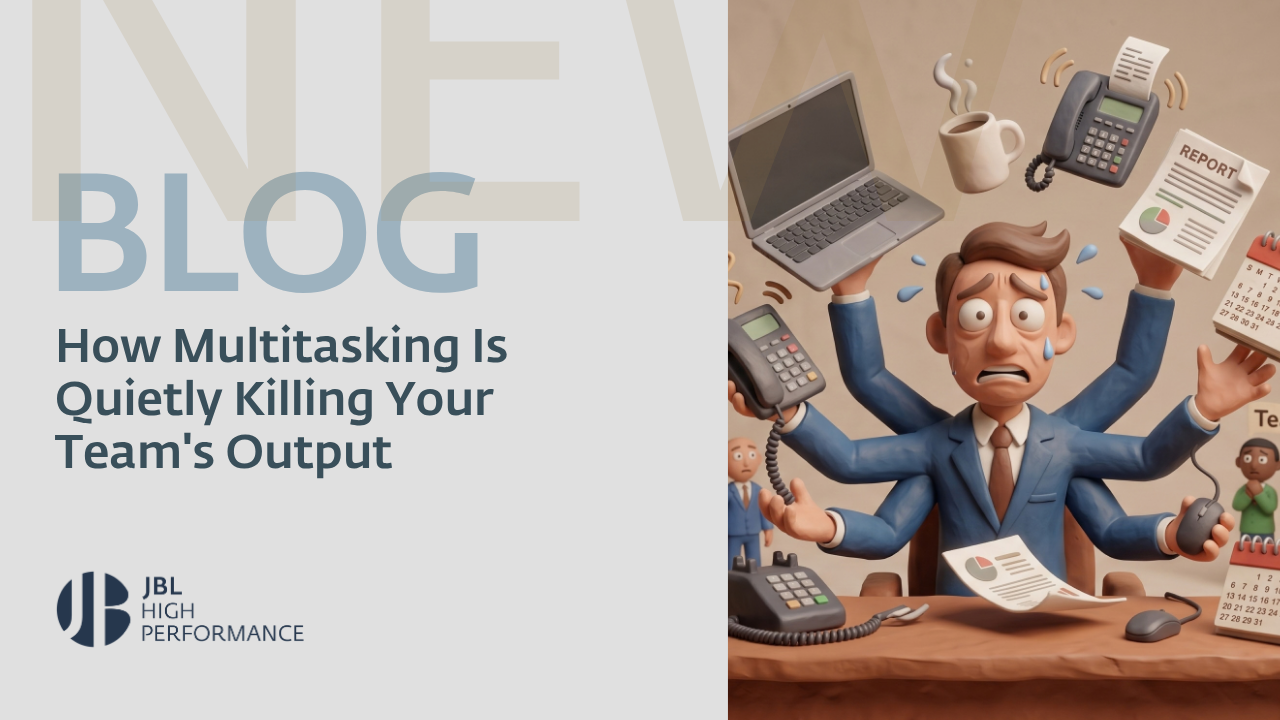
Your mid-level leaders are juggling five projects, responding to emails during meetings, and switching tasks every few minutes. They wear the busyness like a badge of honour, and it is costing you.
They are burning out, and they are taking their effectiveness with them.
Multitasking is a productivity killer that costs organisations millions in lost focus, poor decisions, and leadership burnout. The research is brutal: people who multitask take 50% longer to complete tasks and make 50% more errors.
Your leaders are human beings trying to operate like computers, and it is breaking them.
The Hidden Cost of Scattered Leadership
Watch your leaders in their next meeting. Phones out, messages being answered, three other priorities running in the background. They think they are being efficient.
What they are teaching their teams is that nothing deserves full attention, that every conversation is interruptible, and that focus is optional.
Teams mirror their leaders' behaviour. Meetings become exercises in divided attention. Strategic thinking gets chopped into fragments that never connect into coherent plans.
When leaders cannot focus deeply, strategic initiatives stall. When they are constantly switching contexts, decision quality drops. When they are always on, they burn out and take their teams with them.
A management layer that lives in switching mode produces predictable symptoms across the whole organisation.
- Decisions take longer, because no one holds a thought long enough to finish it.
- Quality drops, because attention is fragmented.
- Your most capable people burn out first, because they are the ones absorbing the overflow.
- The layer below them learns to interrupt rather than decide for themselves.
That is a decision-velocity problem and a retention risk sitting inside the same habit.
Why Your Best Managers Fall Into It
This is not a discipline problem. It is a system problem. Three conditions push capable managers into constant switching.
- Volume. When more comes in than any one person can process, switching feels like the only way to keep every plate spinning.
- Signalling. In many teams, being visibly busy is rewarded more than being quietly effective, so managers perform activity.
- Unclear priority. When nobody has said what matters most this week, everything feels equally urgent, and a manager reacts to whatever shouts loudest.
Notice that all three are conditions you set, not flaws in the person.
Why Your Current Approach Is Not Working
Most organisations reach for time management training. Teach people to prioritise better, use better tools, manage their calendars more effectively.
That treats the symptoms, not the disease.
The real problem is attention management. Your leaders have lost the ability to focus deeply on one thing at a time. They have trained their brains to expect constant stimulation and immediate responses.
- Open office environments make this worse.
- An always-available culture compounds it.
- Meeting-heavy schedules fragment what little focus time remains.
You have created an organisational ADHD epidemic, and traditional productivity training cannot fix it.
The Monotasking Revolution Your Leaders Need
The answer is monotasking: teaching your leaders to do one thing at a time with complete focus and an attention on value and impact.
This is about speeding up by eliminating the hidden costs of task switching, which I have covered in previous blogs (functional, altitude and context). When your brain is not constantly changing gears, it can operate at peak efficiency.
Task switching creates a switching penalty. It takes an average of 23 minutes to fully refocus after an interruption. Your leaders are not losing only the interruption time; they are losing the recovery time too.
Deep Work Sessions
Deep work sessions become non-negotiable calendar blocks. Protected periods where leaders tackle their most critical thinking work, with notifications off, phones silenced, and a quiet space. This is where breakthrough thinking happens.
Task Batching
Task batching eliminates the productivity drain of context switching. Group similar activities together: all one-on-one meetings in one block, all email responses in dedicated time slots, all strategic planning in concentrated sessions. Leaders' brains can stay in one mode rather than constantly shifting gears.
The Power of "No"
The power of "No" becomes a leadership competency. Leaders who focus on doing fewer things exceptionally well deliver more value than scattered multitaskers trying to do everything. Quality over quantity is a competitive advantage.
Are you the bottleneck?
Take the two-minute assessment and see exactly where work is queueing around you, and what to hand over first.
When Leaders Push Back: The Resistance You Will Face
Leaders commonly raise objections such as these:
- "I don't have time for deep work sessions, everything is urgent."
- "My team needs me to be available, I can't just disappear for hours."
- "Multitasking is how I stay on top of everything, without it, things will fall through the cracks."
This resistance is predictable and manageable when you have the right evidence and approach.
Stanford Research
Professor Clifford Nass studied heavy multitaskers and found they are terrible at filtering irrelevant information, managing working memory, and switching between tasks. The people who think they are best at multitasking are actually the worst at it.
Harvard Business School Data
Companies that implemented focused work practices saw a 25% improvement in project completion rates and a 40% reduction in errors requiring rework.
Results from Working with Leaders
Working with 3,000+ leaders, those who implemented monotasking practices reclaimed an average of 6 hours per week and reported improvement in strategic thinking quality and time. One construction GM reduced project delays by 30% by batching his site visits rather than constantly switching between office and field work.
How to Help Leaders Overcome Resistance
Start Small and Prove Value
Do not ask for wholesale calendar changes. Start with one 45 to 90-minute deep work session per week. Track what gets accomplished in that focused time versus scattered work periods. Let the results speak for themselves.
Address the Availability Myth
Help leaders distinguish between being available and being effective. Create office hours where they are accessible for urgent issues, and focus hours where they are unavailable except for genuine emergencies. Most urgent issues can wait 90 minutes.
Provide Practical Tools
- Email Batching Templates: "I check email at 9am, 1pm, and 4pm. For urgent matters, call or text."
- Meeting Buffer Scripts: "I need 15 minutes between meetings to be fully present for each conversation."
- Deep Work Signals: Physical or digital indicators that someone is in focused work mode.
Create Accountability Systems
Pair leaders with monotasking partners who check in weekly on their focus practices. Track and celebrate deep work achievements in leadership meetings. Make focused attention a leadership competency in performance reviews.
Address the Control Addiction
Many leaders multitask because they are addicted to feeling in control of everything. Scattered attention reduces control. When you are focused on one thing, you can influence it powerfully. When you are spread across ten things, you influence nothing effectively.
These are some of the tools and techniques we teach during Amplify, and they work.
Fix the System, Not Just the Person
Individual habits matter, but the conditions you create as a senior leader matter more. If you praise the manager who answered forty messages and overlook the one who finished the decision that unblocked a project, you are training the wrong behaviour. Three changes at the system level will do more than any individual habit shift.
Protect Focus at the System Level
Agree what deep work looks like in your teams and defend it. Blocks of uninterrupted time for the work that actually moves the numbers. Fewer status meetings. Clear priorities set at the start of the week, so managers are not guessing what matters.
Change What You Reward
Reward completion and judgement, not visible busyness. A manager who does a few important things exceptionally well is worth more to your P&L than one who touches everything and finishes nothing.
Give Managers Permission to Say No
Most managers multitask because they have never been explicitly told that protecting their attention is acceptable. Make it a stated expectation, not a guilty secret.
Where is the friction in your team?
The Leadership Friction Finder pinpoints where effort is leaking, so you fix the cause rather than the symptom.
Implementation Strategies That Work
The 30-Day Challenge
Challenge leaders to try monotasking for 30 days. Track their energy levels, decision quality, and strategic output. Most become converts when they experience the difference.
The Meeting Audit
Help leaders audit their calendars. How many meetings could be emails? How many could be shorter? How many could be batched? Often, 30% of meeting time can be reclaimed for focused work.
The Interruption Log
Have leaders track interruptions for one week. What was truly urgent? What could have waited? What patterns emerge? This data usually shocks them into protecting their focus time.
The Energy Mapping Exercise
Help leaders identify their peak energy hours and protect them for their most important work. High-energy time should not go on low-value activities.
The Competitive Advantage of Focused Leaders
Organisations that master monotasking will outperform those that do not. While competitors' leaders are scattered across dozens of priorities, your leaders will be working deeply on the few things that matter most.
Focused leaders make better decisions because they can think problems through completely. They build stronger relationships because they give people their full attention. They get better results because they can see projects through to completion rather than jumping to the next shiny object.
Your customers will notice the difference. Your teams will feel more supported. Your strategic initiatives will get implemented rather than getting lost in the chaos of divided attention.
Start with your senior leadership team. They set the tone for the entire organisation. If they are constantly multitasking, everyone else will follow.
If this sounds like your week
Your managers are not the problem. They are where the problem is stuck.
When your last leadership spend was signed off, did anyone go back to those managers' bosses and ask what changed? That question is the JBL Outcome Standard, and it is how I work.
- Find the friction. A short diagnostic that shows which decisions are stalling, and at what level.
- Am I the bottleneck? Ten questions on where your week is actually going.
- How I work with GMs. Six weeks, one hour a week, up to twelve of your managers, scored by their own bosses.
- Beat Burnout, Boost Performance. The book.
- The High Performance Leader podcast.
Managers I work with reclaim around four hours a week, and their bosses score the change 8.75 out of 10. Would it be a crazy idea to find out how we did this? Book a scoping call.
From the YouTube channel
Watch: more on this topic
A video from the JBL High Performance YouTube channel that goes deeper on the ideas in this article.
How to Stop Multitasking and Boost Your Focus and Productivity in 2024
More on this from the channel
Start this week
Busy all day and still behind?
The Quick-Win Pack is five five-minute fixes for the overloaded leader, each built on a framework I use with paying clients. Every fix runs live on the page and hands you a finished, ready-to-use plan in minutes, with no AI account of your own needed. Just $19, and included free with AMPLIFY and the Six Week Reset.
Get the Quick-Win PackQuestions managers ask about this
How does multitasking affect leadership effectiveness?
Multitasking reduces leadership effectiveness by causing frequent task switching, which leads to longer completion times and more errors. Leaders lose focus, make poorer decisions, and burn out faster. This scattered attention also sets a negative example for teams, resulting in fragmented meetings and stalled strategic initiatives.
What is monotasking and why is it important for leaders?
Monotasking means focusing on one task at a time with full attention. It helps leaders avoid the productivity losses caused by constant switching between tasks. By concentrating deeply, leaders improve decision quality, complete work faster, and reduce burnout, ultimately leading to better strategic thinking and team performance.
How can leaders start implementing monotasking in a busy schedule?
Leaders can begin by scheduling one 45-90 minute deep work session per week with no interruptions. They should batch similar tasks together, like grouping meetings or email responses into dedicated blocks. Setting clear availability hours with the team helps balance responsiveness and focused work time.
What are practical steps to overcome resistance to monotasking?
Start small with limited deep work sessions and measure results to show value. Help leaders separate availability from effectiveness by setting office hours for urgent issues and focus hours for deep work. Use tools like email batching templates and meeting buffer scripts, and create accountability through peer check-ins and performance reviews.
Explore this topic
Hear this discussed on the podcast
Episodes of The High Performance Leader that cover the same ground.

Jimmy Burroughes
FounderFormer British Army officer and corporate GM who has transformed nearly 3,500 managers into leaders across 30+ organisations. Creator of the Simplify to Amplify methodology, author of Beat Burnout, Ignite Performance, and two-time Global Recognition Award winner.
Keep exploring
Want to know where the drag really is?
Before you change anything, get an honest read on the friction slowing your team down. Take a short, free diagnostic and see exactly where the time is going.