


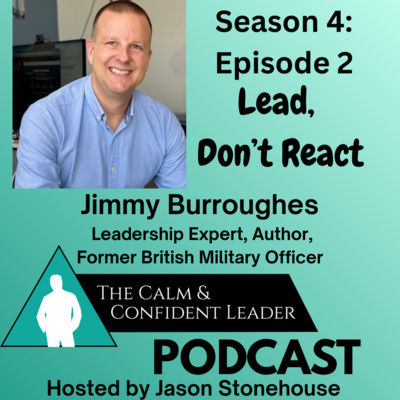
Lead, Don't React
Managers and senior leaders who feel overwhelmed by operational noise, back-to-back meetings, and the urge to fix every problem themselves.
What the conversation covers
In this conversation with host Jason Stonehouse, Jimmy addresses the trap of firefighting mode, where leaders spend their entire working day reacting to problems instead of setting direction. Drawing on his military background, Jimmy points out that leaders often rush in because they mistakenly believe they must be the expert, or because they assume their team is incapable. Acting as what he calls the 'village fisherman' keeps the leader tactical, limits their own career growth, and stops team members from gaining the experience needed to improve.
To diagnose why a team member or leader is underperforming, Jimmy presents a framework focused on identifying whether the issue stems from a lack of skill, a lack of will, or a blind spot. A skill deficit requires training and structured processes, while an issue of will demands an honest evaluation of trust and alignment. Blind spots, on the other hand, are often resolved simply through clear communication about expectations and what good performance actually looks like, rather than applying generic management solutions.
Jimmy also outlines his Simplify to Amplify method, which helps overloaded organisations focus exclusively on the small handful of initiatives that deliver significant impact with minimal effort. Instead of attempting to do everything, leaders need to step into the role of an icebreaker: building psychological safety within the team and clearing institutional obstacles ahead of them. Moving away from being constantly available creates the mental capacity required to drive strategic outcomes.
To help overwhelmed leaders regain control immediately, Jimmy recommends cutting standard meeting lengths from 60 minutes to 45 minutes to create regular recovery windows. He advocates auditing calendar invites using objective criteria, declining low-value meetings to reclaim around eight hours every week, and dedicating that recovered time to planning and deep, uninterrupted work.
“If you're busy solving everybody's individual problems, you're not building psychological safety and trust as a team.”
Key takeaways
- Diagnose team performance problems by identifying whether the root cause is a deficit in skill, a lack of will, or an unrecognised blind spot.
- Use the question 'What do you suggest?' when staff present issues, encouraging team problem-solving rather than constantly providing answers.
- Shift the leadership identity from a 'village fisherman' who catches all the food to an 'icebreaker' who clears obstacles and builds psychological safety.
- Focus strategy on the top one to three initiatives that provide maximum impact for the least effort, ignoring lower-value tasks.
- Shorten 60-minute meetings to 45 minutes to build in 15-minute intervals for thinking, planning, and mental recovery throughout the working day.
- Decline low-value meetings to reclaim up to eight hours weekly, reallocating that time toward planning and focused deep-work blocks.
Where this shows up in your business
The ideas in this conversation come from the Simplify to Amplify method. To see where friction is costing your team time, try the free Leadership Friction Finder, or browse all of Jimmy's guest appearances.
Summary written by JBL High Performance from the episode audio. The episode belongs to Calm and Confident Leader Podcast and Jason Stonehouse.