Why Do Reorganizations Fail? The Org Chart Was Never Carrying The Problem
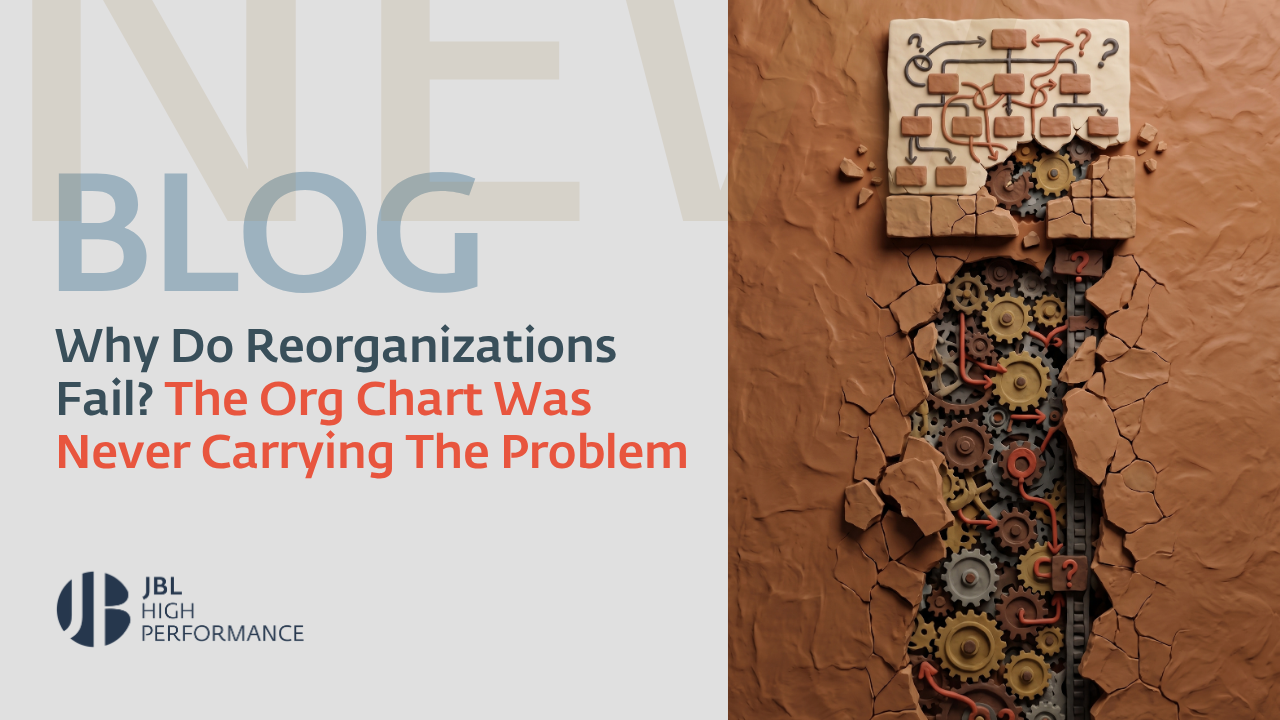
Answer: Reorganizations fail because they change who reports to whom and leave alone who's allowed to decide what. The escalations that pushed you into the restructure get a new route rather than an ending. Eighteen months on, the same calls are landing on the same desk under different job titles, and somebody opens the org chart again.
I've sat with GMs on their third restructure in five years. All three were designed by people who believed, honestly, that the first two had been badly executed.
Why do most reorganizations fail to improve performance?
Picture an energy network business. Poles, wires, field crews, an outage map that turns red on a bad night. The regional operations manager has spent two years asking for a structure with cleaner accountability and she's finally getting one. Field delivery splits away from network planning, two new heads get appointed, and a small programme office goes in to hold the seams together.
Now watch her Tuesday, six weeks after go-live. A contractor call-out sat on her phone at ten past seven, four hundred dollars over a spend threshold nobody reissued under the new structure. A switching decision she used to take in ninety seconds has been parked since yesterday morning, because the man who'd normally make it reports into planning now and won't guess at whether it's still his to make. And her calendar carries more meetings than it did in March, most of them existing to reconnect two functions that used to sit in one conversation.
Her reporting line changed. Her week didn't.
The reason is dull and it's the whole thing. A restructure is a set of decisions about reporting relationships. The friction in your business is a set of decisions about authority, and those two live on different maps. You can redraw the first on a Friday afternoon. The second is carried in the heads of a hundred and forty managers, most of whom worked out where their authority stops by watching what happened to somebody who overstepped it.
What causes the problem a restructure is trying to fix?
Three things turn up in every over-complicated business, and I look for them before I look at an org chart.
Turnover's up and it's the capable people going. The ones still there look strung out and can't tell you what this week's priorities are, because there are somewhere north of forty of them. A layer below that, nobody has any line of sight to the strategy at all. I just turn up and do my job.
None of that is a reporting problem. That's what a management layer looks like when the decisions belonging to it have drifted upward and the work belonging above it has drifted down. Your managers are standing at the one point in the business where the most decisions meet the least authority. They didn't build that. They're carrying it, and carrying it is what makes capable people look slow.
Here's the part that stings. The last reorg is often what put the drift there. Every restructure resets who's allowed to do what, and for the months it takes to resettle, the safest move available to any manager is to ask. Ask enough times and asking becomes the habit. The escalations climb, somebody diagnoses a structure problem, and you're back at the top of the loop holding a fresh set of boxes.
How long does it take a reorganization to show results?
Longer than the patience of whoever commissioned it, which is why so few get honestly evaluated. Give it the eighteen months it needs to bed in and by then the market's moved, or a new leader has arrived with a view about structure, which is how the third reorg in five years gets born.
If you're going ahead anyway, and sometimes you should, write down the number you expect to move before you move a single box. Escalation volume, hours your managers get back each week, cycle time on the decisions that keep coming round. Two weeks of counting before the announcement goes out. Everybody skips that step, which is why the argument about whether the last one worked is still running.
What should you do instead of restructuring?
Change who decides, and leave the boxes where they are.
Take the fifteen to twenty decisions that keep coming round in your business. Not the interesting ones; the dull recurring ones, like the spend threshold, or the exception that arrives every Tuesday, or the resourcing clash between two managers who don't report to each other and have never been told which of them settles it. Name an owner for each at the lowest level where the information already sits, tell that person out loud that it's theirs, then make peers settle sideways before anything travels up.
That's a fortnight of work, and the org chart stays exactly where it is.
I ran exactly that with one cohort of managers at a $560M dairy manufacturer. Same headcount, same people in the same jobs. Escalations came down 15%. Forty percent more decisions were getting settled at the right level, around ninety percent of what used to climb was being resolved between peers instead, and each manager got roughly four hours a week back. Ninety days later their own bosses scored it, having watched their own teams the whole time, and put it at 8.75 out of 10 that they'd run it again. That last number is the one I'd look at first. Nobody spends a budget twice to be polite.
How to tell whether you've got a structure problem or a decision problem
Log every decision that reaches you from your direct reports and one level below. Two weeks. Next to each, write whose call it should have been under your own policy, and why it didn't stop there.
The reasons come out short. Either nobody owns it, or somebody owns it and has never been told, or somebody owns it and doesn't believe owning it is safe. Each has a different fix, and none of them needs a new org chart.
If more than a third of that list belonged a level or two below you, restructuring will feel like progress for about a quarter, and then the same decisions will start arriving again.
FREQUENTLY ASKED QUESTIONS
Why do reorganizations fail so often?
Because they move reporting lines and leave decision rights untouched. The work that was climbing to your desk keeps climbing by a different route, and the transition makes managers more cautious about deciding for a while.
Should I restructure to reduce escalations?
No. Escalations are a decision-rights problem and a restructure makes them worse before it makes them anything. Restructure for duplicated ownership, or for a span that arithmetic says can't work.
What's the alternative to reorganizing?
Name owners for the recurring decisions at the lowest sensible level, say it out loud rather than writing it down, and require peers to settle sideways before anything travels up. It takes about two weeks and it's reversible if you get it wrong.
Jimmy Burroughes, JBL High Performance. Simplify to Amplify.
If any of this sounds familiar, here's where to start
- Not sure where the friction is building in your management layer? → See where decisions stall, escalations pile up, and where good people burn out
- Wondering if you've become the bottleneck yourself? → Take the free 5-minute assessment
Start this week
Busy all day and still behind?
The Quick-Win Pack is five five-minute fixes for the overloaded leader, each built on a framework I use with paying clients. Every fix runs live on the page and hands you a finished, ready-to-use plan in minutes, with no AI account of your own needed. Just $19, and included free with Amplify and the Six Week Reset.
Get the Quick-Win PackExplore this topic

Jimmy Burroughes
FounderFormer British Army officer and corporate GM who has transformed nearly 3,500 managers into leaders across 30+ organisations. Creator of the Simplify to Amplify methodology, author of Beat Burnout, Ignite Performance, and two-time Global Recognition Award winner.
Keep exploring
Want to know where the drag really is?
Before you change anything, get an honest read on the friction slowing your team down. Take a short, free diagnostic and see exactly where the time is going.