

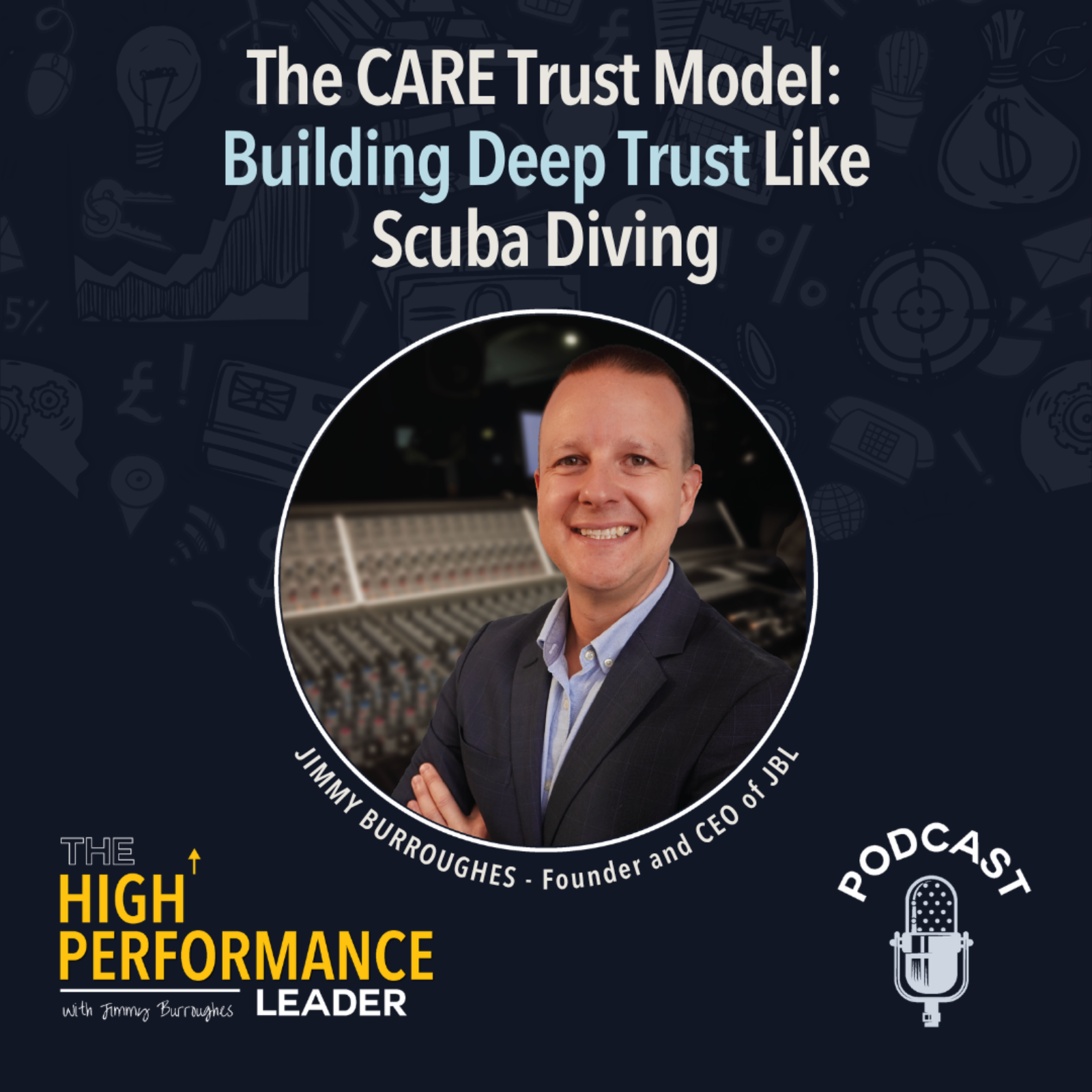
Episode 53: The CARE Trust Model: Building Deep Trust Like Scuba Diving
Also on Spotify and Apple Podcasts.
In this episode, host Jimmy Burroughes introduces a practical framework for understanding and building trust in leadership relationships. Using his experience as a scuba diver as an analogy, he presents the CARE model, a systematic way to measure and develop trust across four distinct levels, from surface-level professional interactions through to deep emotional trust. It gives you a simple way to map exactly where your key relationships stand today.
Free Digital Asset: Are You the Bottleneck? Free Leadership Assessment — https://jblhighperformance.com/am-i-the-bottleneck
Episode highlights:
(0:00) Intro
(1:07) Scuba diving as a trust analogy
(4:20) Introduction to the CARE model
(4:36) Cognitive trust
(5:02) Aligned trust
(5:28) Relational trust
(6:02) Emotional trust
(6:59) Why trust is measured differently at each level
(8:05) Exercise: mapping your team relationships
(8:15) Outro
Follow and Subscribe to Jimmy Burroughes
LinkedIn: https://www.linkedin.com/in/jimmyburroughes/
Website: https://jblhighperformance.com/
Instagram: https://www.instagram.com/jimmybleadership/
Beat Burnout - Ignite Performance is now available to download. Get a copy now at: https://jblhighperformance.com/books
Start this week
Turn this episode into action today
The Quick-Win Pack is five five-minute fixes for the overloaded leader, each built on a framework I use with paying clients. Every fix runs live on the page and hands you a finished, ready-to-use plan in minutes, with no AI account of your own needed. Just $19, and included free with AMPLIFY and the Six Week Reset.
Get the Quick-Win PackIn this episode, host Jimmy Burroughes introduces the "CARE" trust model, drawing an extended analogy between levels of workplace trust and the depth levels of scuba diving. He outlines how trust moves from superficial intellectual alignment (Cognitive and Aligned) down to vulnerable emotional connections (Relational and Emotional), where the stakes and rewards are significantly higher. Jimmy encourages leaders to evaluate their team relationships against these tiers to build genuine psychological safety and high-performance cultures.
"The deeper we go in diving, the more complicated it becomes."
"When you're at this superficial level of trust, when you're snorkeling in trust, then, you know, you don't really see as much as anybody else, but there's no danger if it goes wrong."
"The top two layers, our cognitive and our aligned trust, we think them. They're intellectual... The bottom two layers are much more heart or gut-driven. I feel like I can trust them."
"It's more challenging to work down those layers, but you get it wrong, instantly you're back up."
***
Podcast Introduction
[00:00] JIMMY: Welcome to this episode of The High Performance Leader, the podcast for leaders working in complex, challenging environments to gain insights and ideas which help you increase your impact without burning out and to help you build a high-performance culture in your team. I'm your host, Jimmy Burroughes. And if you're new to The High Performance Leader, make sure you subscribe or follow so you don't miss any of our upcoming episodes before you put down your device.
The Scuba Diving Analogy of Trust
I'm a a scuba diver, and I kind of came up with this model thinking about thinking about trust a bit like scuba diving. Does anybody else scuba dive? Wow. We need to scuba dive scuba nerd out.
So in in my mind, there's kind of four four levels of scuba diving that we can go to. So you start off at the top um with a snorkel, and you're on the surface, and you're paddling around, and you put your face in the water, and you see some fishes and turtles, and it's wonderful. And then if you get bored, you get out. Yeah, there's no danger, really. It's it's pretty safe. There's not much training required, and you can do it whenever you want. Does that sound reasonable? Yes, that sounds perfect. No sharks. In the Maldives, where the water is warm as well. And you when you come onto the boat, they hand you a cocktail.
[01:14] Then we might say, "Hey, do you know what? I want to go and see something else. I want to go a little bit deeper to see some different things. So I'm going to learn how to do PADI Open Water Scuba course," which is the most basic course. It takes you to 18 m. And so you get to go and blow bubbles and look at fishies and sea turtles. Uh but if anything goes really wrong, you can just swim to the surface. There's no consequences um or very few consequences. And you know, even if you were to just dump your gear on the bottom of the ocean at 18 m, you could swim to the surface. Uh so we do our Caesar Ascent, and we do all these things. And and that's fun.
But then you after a little bit of time, you're like, "Ah, but there's stuff I still can't see, and there's some mysteries of the ocean I want to explore more. And that wreck that I want to go and check out is at 40 m." So I need to do my my recreational 30-m Advanced Open Water, and then they need to do my deep my deep qual and my wreck qual to get down to that that 40 m where that wreck is. And I want to go and see it. But all of a sudden, we have to start learning extra things about decompression and physics and the dangers of surfacing too quickly. And it becomes a little bit more complicated. The deeper we go in diving, the more complicated it becomes.
[02:22] And then, finally, you end up like a couple of buddies of mine in Cabo that go, "We want to dive to 154 m." And that requires a lot of skill. It takes about 2 weeks to plan that dive. It takes about 6 7 hours to do that dive. And if one thing goes wrong, like one tiny thing goes wrong, it can cause a catastrophic chain of events. So much so that three guys three of my friends dived, one was my dive mentor, two are my good buddies, and there was a small mistake under water, and they were actively discussing under water who they were leaving behind at 100-and-something meters. The consequences of getting it wrong are really high.
And it's dark down there, and it's dangerous down there, but you get to see things you'll never see on the surface snorkeling or even at 18 m. And I think trust is kind of similar. Because when you're at this superficial level of trust, when you're snorkeling in trust, then, you know, you don't really see as much as anybody else, but there's no danger if it goes wrong. And as you go down and down and down the layers of trust, you need a bit more training, you need a bit more skill to navigate it, and the consequences of getting it wrong are a bit higher. But, my goodness, do you see some amazing things that nobody else gets to see.
The CARE Model: Cognitive and Aligned Trust
[03:37] And so we created this this model, CARE, to essentially try and systematize how we think about trust. Can we put this into something that you can grasp it and go, "Now I know where I'm at with the people I work with. Now I know where I'm at in my relationships."
So let's have a look at it. "C" is all about cognitive trust. So essentially what that means is I intellectually trust you, because you've got a degree, and you were hired here, so you've got to be not terrible, all right? It's just we're at snorkeling level. You know, I don't really trust you, but because you got hired here, I kind of have to trust you. And so I'll give you the benefit of the doubt, and I'll get into a conversation with you, but I'm not sharing anything more important than that. Does that sound familiar? Yep, you got hired here. Yeah, you're probably okay.
The second layer of trust is what we call aligned trust. This is probably where many of us are at with most of our work relationships is we work on stuff together. We do tasks, and we do processes together. And that means that I've got to have a little bit more trust in, "Oh, actually we've got to do some stuff. I need to talk to you more, I need to engage with you more, I need to show you a little bit more of me." Sound familiar? Great.
Relational and Emotional Trust
[04:45] And then things start to get a bit more serious. We're going to move down a layer into our relational level of trust. And relational level of trust is where we start talking about favors and mistakes. So, "Hey, can I bother you for this? Could you help me with this? Would it be okay if if you and I work together on this? I'm actually a little bit um sorry. I I messed this up. Could we talk about that? It's not going how I expected." You see how the conversations become a bit more consequential, right? And if you don't have trust with that other person, and you start talking about favors and mistakes, the relationship bank account has got no money in it, what are they going to say? "No," end of relationship. So you've got to build some trust.
And then there'll be a few people in your world that you have what we call an emotional level of trust. An emotional level of trust is the deepest, most dangerous level of trust to get to, but also the most rewarding, because you see things that nobody else sees. That's where we talk about confessions and fears: "I'm really worried about this. I'm genuinely scared about this. I really screwed this up. I've got a serious health condition. I'm struggling with an addiction to. I'm a bad person because." All of these things are you need to really trust somebody to share this, or you're a massive oversharer. But nobody really likes a big oversharer, because there's a misbalance in the level of trust, right? You're oversharing with me about this stuff, and I'm like, "Whoa, chatty. We just work together on stuff. I'm not interested."
[06:05] And this is the scary part, because it's very hard not very hard, it it's more challenging to work down those layers, but you get it wrong, instantly you're back up. Yep. Awesome.
Thinking Trust vs. Feeling Trust
It's interesting how we look at these things and how we measure them as well. So, in my belief, our top two layers, our cognitive and our aligned trust, we think them. They're intellectual. "I think I can trust that person. I think I like them. I think I can work with them." This stuff over here The The bottom two layers are much more heart or gut-driven. "I feel like I can trust them."
And we tend to measure them differently as well. We measure our our cognitive and aligned by external measures. So, have they got a degree? Do they work here? Do they deliver on time? Uh do they make sure Do they hit deadlines? Do they Are they 100% right all the time? It's an external validation or external measurement. The the relational and emotional stuff is is much more internal. We feel it, right? We we sense it.
And there's lots of clever science research, and if you want to get drunk one day and talk in a pub about this stuff, I can nerd out for days on it with you. But suffice to say, there's some neurons inside your gut and your heart that actually give you these feeling and gut instincts that align with this stuff. And they go right back to sort of prehistoric times.
Applying the CARE Model
So it's pretty cool, right? Trust is pretty cool. So what I'd like you to do is to list the people in your team, choose a couple of them, and just assign a letter. Where do I think those relationships are right now? There's no right or wrong answers. It's what you think. How much do you trust that person?
Outro
[07:37] That's it for this week's episode of The High Performance Leader. If you enjoyed this episode, please drop a review on whichever platform you listened on. We really appreciate it, and it helps us to connect with new listeners. Also, if you haven't already, head to jblhighperformance.com and download a copy of my latest bestseller, *Beat Burnout - Ignite Performance*. It's the leader's playbook for building a high-performance culture, and is packed with practical action tips to get you started. Stay tuned for next week's episode of game-changing insights and ideas on The High Performance Leader.
In this episode, host Jimmy Burroughes introduces the "CARE" trust model, drawing an extended analogy between levels of workplace trust and the depth levels of scuba diving. He outlines how trust moves from superficial intellectual alignment (Cognitive and Aligned) down to vulnerable emotional connections (Relational and Emotional), where the stakes and rewards are significantly higher. Jimmy encourages leaders to evaluate their team relationships against these tiers to build genuine psychological safety and high-performance cultures.
"The deeper we go in diving, the more complicated it becomes."
"When you're at this superficial level of trust, when you're snorkeling in trust, then, you know, you don't really see as much as anybody else, but there's no danger if it goes wrong."
"The top two layers, our cognitive and our aligned trust, we think them. They're intellectual... The bottom two layers are much more heart or gut-driven. I feel like I can trust them."
"It's more challenging to work down those layers, but you get it wrong, instantly you're back up."
***
Podcast Introduction
[00:00] JIMMY: Welcome to this episode of The High Performance Leader, the podcast for leaders working in complex, challenging environments to gain insights and ideas which help you increase your impact without burning out and to help you build a high-performance culture in your team. I'm your host, Jimmy Burroughes. And if you're new to The High Performance Leader, make sure you subscribe or follow so you don't miss any of our upcoming episodes before you put down your device.
The Scuba Diving Analogy of Trust
I'm a a scuba diver, and I kind of came up with this model thinking about thinking about trust a bit like scuba diving. Does anybody else scuba dive? Wow. We need to scuba dive scuba nerd out.
So in in my mind, there's kind of four four levels of scuba diving that we can go to. So you start off at the top um with a snorkel, and you're on the surface, and you're paddling around, and you put your face in the water, and you see some fishes and turtles, and it's wonderful. And then if you get bored, you get out. Yeah, there's no danger, really. It's it's pretty safe. There's not much training required, and you can do it whenever you want. Does that sound reasonable? Yes, that sounds perfect. No sharks. In the Maldives, where the water is warm as well. And you when you come onto the boat, they hand you a cocktail.
[01:14] Then we might say, "Hey, do you know what? I want to go and see something else. I want to go a little bit deeper to see some different things. So I'm going to learn how to do PADI Open Water Scuba course," which is the most basic course. It takes you to 18 m. And so you get to go and blow bubbles and look at fishies and sea turtles. Uh but if anything goes really wrong, you can just swim to the surface. There's no consequences um or very few consequences. And you know, even if you were to just dump your gear on the bottom of the ocean at 18 m, you could swim to the surface. Uh so we do our Caesar Ascent, and we do all these things. And and that's fun.
But then you after a little bit of time, you're like, "Ah, but there's stuff I still can't see, and there's some mysteries of the ocean I want to explore more. And that wreck that I want to go and check out is at 40 m." So I need to do my my recreational 30-m Advanced Open Water, and then they need to do my deep my deep qual and my wreck qual to get down to that that 40 m where that wreck is. And I want to go and see it. But all of a sudden, we have to start learning extra things about decompression and physics and the dangers of surfacing too quickly. And it becomes a little bit more complicated. The deeper we go in diving, the more complicated it becomes.
[02:22] And then, finally, you end up like a couple of buddies of mine in Cabo that go, "We want to dive to 154 m." And that requires a lot of skill. It takes about 2 weeks to plan that dive. It takes about 6 7 hours to do that dive. And if one thing goes wrong, like one tiny thing goes wrong, it can cause a catastrophic chain of events. So much so that three guys three of my friends dived, one was my dive mentor, two are my good buddies, and there was a small mistake under water, and they were actively discussing under water who they were leaving behind at 100-and-something meters. The consequences of getting it wrong are really high.
And it's dark down there, and it's dangerous down there, but you get to see things you'll never see on the surface snorkeling or even at 18 m. And I think trust is kind of similar. Because when you're at this superficial level of trust, when you're snorkeling in trust, then, you know, you don't really see as much as anybody else, but there's no danger if it goes wrong. And as you go down and down and down the layers of trust, you need a bit more training, you need a bit more skill to navigate it, and the consequences of getting it wrong are a bit higher. But, my goodness, do you see some amazing things that nobody else gets to see.
The CARE Model: Cognitive and Aligned Trust
[03:37] And so we created this this model, CARE, to essentially try and systematize how we think about trust. Can we put this into something that you can grasp it and go, "Now I know where I'm at with the people I work with. Now I know where I'm at in my relationships."
So let's have a look at it. "C" is all about cognitive trust. So essentially what that means is I intellectually trust you, because you've got a degree, and you were hired here, so you've got to be not terrible, all right? It's just we're at snorkeling level. You know, I don't really trust you, but because you got hired here, I kind of have to trust you. And so I'll give you the benefit of the doubt, and I'll get into a conversation with you, but I'm not sharing anything more important than that. Does that sound familiar? Yep, you got hired here. Yeah, you're probably okay.
The second layer of trust is what we call aligned trust. This is probably where many of us are at with most of our work relationships is we work on stuff together. We do tasks, and we do processes together. And that means that I've got to have a little bit more trust in, "Oh, actually we've got to do some stuff. I need to talk to you more, I need to engage with you more, I need to show you a little bit more of me." Sound familiar? Great.
Relational and Emotional Trust
[04:45] And then things start to get a bit more serious. We're going to move down a layer into our relational level of trust. And relational level of trust is where we start talking about favors and mistakes. So, "Hey, can I bother you for this? Could you help me with this? Would it be okay if if you and I work together on this? I'm actually a little bit um sorry. I I messed this up. Could we talk about that? It's not going how I expected." You see how the conversations become a bit more consequential, right? And if you don't have trust with that other person, and you start talking about favors and mistakes, the relationship bank account has got no money in it, what are they going to say? "No," end of relationship. So you've got to build some trust.
And then there'll be a few people in your world that you have what we call an emotional level of trust. An emotional level of trust is the deepest, most dangerous level of trust to get to, but also the most rewarding, because you see things that nobody else sees. That's where we talk about confessions and fears: "I'm really worried about this. I'm genuinely scared about this. I really screwed this up. I've got a serious health condition. I'm struggling with an addiction to. I'm a bad person because." All of these things are you need to really trust somebody to share this, or you're a massive oversharer. But nobody really likes a big oversharer, because there's a misbalance in the level of trust, right? You're oversharing with me about this stuff, and I'm like, "Whoa, chatty. We just work together on stuff. I'm not interested."
[06:05] And this is the scary part, because it's very hard not very hard, it it's more challenging to work down those layers, but you get it wrong, instantly you're back up. Yep. Awesome.
Thinking Trust vs. Feeling Trust
It's interesting how we look at these things and how we measure them as well. So, in my belief, our top two layers, our cognitive and our aligned trust, we think them. They're intellectual. "I think I can trust that person. I think I like them. I think I can work with them." This stuff over here The The bottom two layers are much more heart or gut-driven. "I feel like I can trust them."
And we tend to measure them differently as well. We measure our our cognitive and aligned by external measures. So, have they got a degree? Do they work here? Do they deliver on time? Uh do they make sure Do they hit deadlines? Do they Are they 100% right all the time? It's an external validation or external measurement. The the relational and emotional stuff is is much more internal. We feel it, right? We we sense it.
And there's lots of clever science research, and if you want to get drunk one day and talk in a pub about this stuff, I can nerd out for days on it with you. But suffice to say, there's some neurons inside your gut and your heart that actually give you these feeling and gut instincts that align with this stuff. And they go right back to sort of prehistoric times.
Applying the CARE Model
So it's pretty cool, right? Trust is pretty cool. So what I'd like you to do is to list the people in your team, choose a couple of them, and just assign a letter. Where do I think those relationships are right now? There's no right or wrong answers. It's what you think. How much do you trust that person?
Outro
[07:37] That's it for this week's episode of The High Performance Leader. If you enjoyed this episode, please drop a review on whichever platform you listened on. We really appreciate it, and it helps us to connect with new listeners. Also, if you haven't already, head to jblhighperformance.com and download a copy of my latest bestseller, *Beat Burnout - Ignite Performance*. It's the leader's playbook for building a high-performance culture, and is packed with practical action tips to get you started. Stay tuned for next week's episode of game-changing insights and ideas on The High Performance Leader.
Read more on this
Latest episode: Episode 59: From Engagement Scores to Execution Clarity: How to Decongest Your Leadership System. New to the show? Start with The High Performance Leader: Show Trailer.