The Trust Check: Why Silence is the Loudest Warning Sign
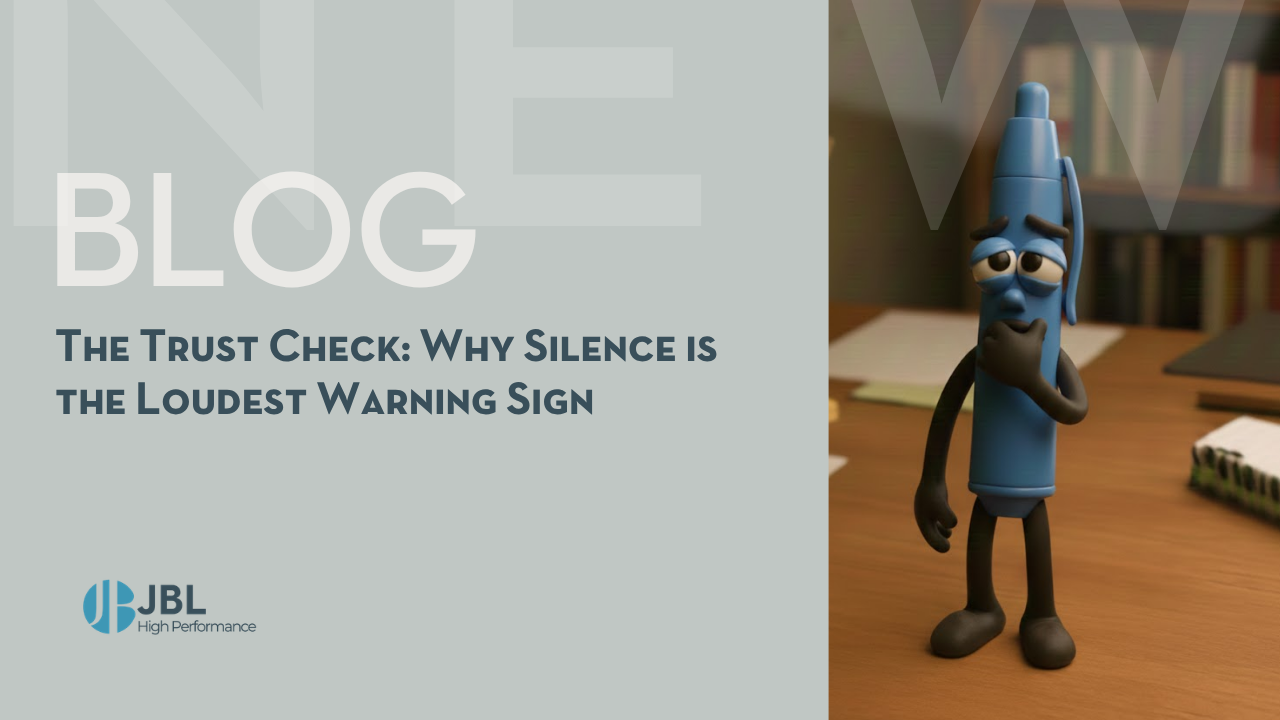
Your managers look aligned. Meetings are civil. Nobody is openly kicking off. And yet escalations keep climbing, decisions get revisited, and execution feels heavier than it should.
That is not harmony. That is silence. And silence in a leadership team is one of the most expensive operational problems you can have, because it compounds invisibly until it shows up in your delivery numbers.
No team ever says they have a trust problem. What you hear instead is "we need better communication," "people aren't accountable," or "there's some misalignment." It sounds operational. It sounds fixable. But when escalations keep climbing and your managers are staying close to everything because they are not confident it will get done without them, that is not a communication issue. It is a trust issue.
It Does Not Look Like Conflict
When most people think about low trust, they picture tension. Open disagreement. Friction between teams.
In reality, low trust is much quieter than that. It looks like politeness. It looks like agreement in the room and different behaviour outside it. It looks like people keeping their heads down and getting on with it.
It is invisible on a survey and visible in your cost base.
Low trust does not announce itself. It shows up in operational drag: decisions take longer because people keep checking and rechecking, leaders stay close to everything because they cannot rely on the outcome if they step back, feedback gets softened to the point it becomes useless, and meetings repeat conversations that should have been settled weeks ago. None of these get labelled as trust issues. But they all point to the same structural problem. People are not safe enough to be honest or confident enough to rely on each other.
The Problem with Treating Trust as One Thing
Most organisations treat trust as a single switch: either it is there or it is not. That is why the fixes fail.
You can trust someone to hit a deadline and not trust their judgement in a high-stakes meeting. You can have a team that gets along personally and still watch them pull in different directions the moment a difficult decision lands.
To fix trust, you have to know which part of it is broken. The CARE model breaks this down into four distinct pillars: Cognitive, Aligned, Relational, and Emotional. Each one creates a different type of friction when it fails.
The Four Pillars of Trust
Cognitive Trust: the Competence Baseline
This is the foundational question: do your leaders believe the people around them can do the job?
When cognitive trust is low, you see managers staying far too close to the detail. Double-checking work that should be finished. Hovering over decisions that should sit lower. It is not always personal, but it is a clear signal that confidence in capability has eroded.
The operational cost is direct: senior time gets consumed by work it should never touch.
Capacity drains. Bottlenecks form. And the manager who cannot step back becomes the constraint on everything beneath them.
Aligned Trust: the Direction Problem
Even a capable team fails if they are pulling in different directions. This is where you see people nodding in agreement in meetings and doing something different the moment they leave the room.
Most organisations label this a communication problem. It is not. It is a misalignment of priorities.
When aligned trust is low, rework increases, conversations get repeated, and delivery slows at every handover point. You end up running more meetings to create the clarity that should already exist, which is exactly the pattern that overloads your managers.
Relational Trust: the "Have My Back" Factor
This is how people experience each other's motives. Do I believe you are acting in good faith, or are you chasing your own agenda at my expense?
When relational trust is low, information gets withheld. People become defensive. Focus shifts from collective delivery to individual protection.
Politics in a leadership team is not a culture issue. It is a structural friction issue. And it has a direct commercial cost in slowed decisions, reduced candour, and senior leaders who spend time managing internal conflict instead of driving performance.
Emotional Trust: the Silence Risk
This is the pillar most organisations miss entirely, because on the surface everything looks fine. Meetings are polite. Nobody is causing problems.
But that calm is often artificial harmony born out of fear. People are not raising issues. They are not admitting mistakes. They are not challenging decisions that deserve to be challenged.
When emotional trust is missing, your managers learn to manage upwards rather than solve problems. Issues sit unspoken until they become expensive. Escalations spike not because the problem is new, but because nobody felt safe raising it earlier.
Are you the bottleneck?
Take the two-minute assessment and see exactly where work is queueing around you, and what to hand over first.
What Low Trust Is Costing You
The commercial cost of low trust compounds quietly. More meetings than necessary. Rework that should not exist. Senior leaders carrying decisions that should sit lower because it feels easier than relying on others.
From the outside, the team looks busy. On the inside, execution is heavier than it needs to be. Teams with low trust deliver, but they deliver at a higher cost in time, energy, and attrition than teams with clean accountability and honest communication.
Where Trust Is Actually Built
Trust is not built through offsites or values refreshes. It is built through small, consistent behaviours repeated across the management layer:
- Following through on what leaders say they will do.
- Addressing issues directly instead of letting them sit.
- Creating space for honest conversations, including the uncomfortable ones.
- Reacting well when things go wrong so people do not learn to hide problems.
Your managers take their cue from their leaders. If senior leaders are guarded, managers will be guarded. If difficult conversations get avoided at the top, they get avoided everywhere below.
A team workshop will not rebuild trust. A new set of values on a wall will not rebuild it either. What works is consistency. Say what you will do, then do it. Address the issue that everyone is walking around. Create accountability structures that make follow-through visible.
This is not soft work. It is the structural foundation that determines whether your managers can delegate, decide, and deliver without constant intervention from above.
Where is the friction in your team?
The Leadership Friction Finder pinpoints where effort is leaking, so you fix the cause rather than the symptom.
How to Use This in Practice
Before you invest in another development initiative, run a quick trust diagnostic across your leadership tier using these four questions:
- Where are leaders staying too close to the detail? That is a cognitive trust signal.
- Where are decisions being revisited after they were supposedly made? That is an alignment signal.
- Where is information being withheld or filtered before it travels up? That is a relational trust signal.
- Where are issues surfacing late, or not at all? That is an emotional trust signal.
Each answer points to a different intervention. And knowing which one you are dealing with is the difference between fixing the actual problem and running another programme that does not shift behaviour.
Run the Trust Check Across Your Management Layer
Silence is rarely agreement. A short diagnostic shows you where issues are sitting unspoken and where that is slowing decisions.
- Find the friction in your management layer. A short, free diagnostic that shows which decisions are stalling, and at what level. Benchmarked against similar operations.
- Are you the bottleneck? Ten quick questions on where your own week is actually going.
- How I work with GMs. Six weeks, one hour a week, up to twelve of your managers, scored by their own bosses.
Managers I work with reclaim around four hours a week, and their bosses score the change 8.75 out of 10. Would it be a crazy idea to find out how we did this? Book a scoping call.
Start this week
Busy all day and still behind?
The Quick-Win Pack is five five-minute fixes for the overloaded leader, each built on a framework I use with paying clients. Every fix runs live on the page and hands you a finished, ready-to-use plan in minutes, with no AI account of your own needed. Just $19, and included free with AMPLIFY and the Six Week Reset.
Get the Quick-Win PackExplore this topic
Hear this discussed on the podcast
Episodes of The High Performance Leader that cover the same ground.

Jimmy Burroughes
FounderFormer British Army officer and corporate GM who has transformed nearly 3,500 managers into leaders across 30+ organisations. Creator of the Simplify to Amplify methodology, author of Beat Burnout, Ignite Performance, and two-time Global Recognition Award winner.
Keep exploring
Want to know where the drag really is?
Before you change anything, get an honest read on the friction slowing your team down. Take a short, free diagnostic and see exactly where the time is going.