Escalations Are Not a People Problem. They Are a System Design Problem.
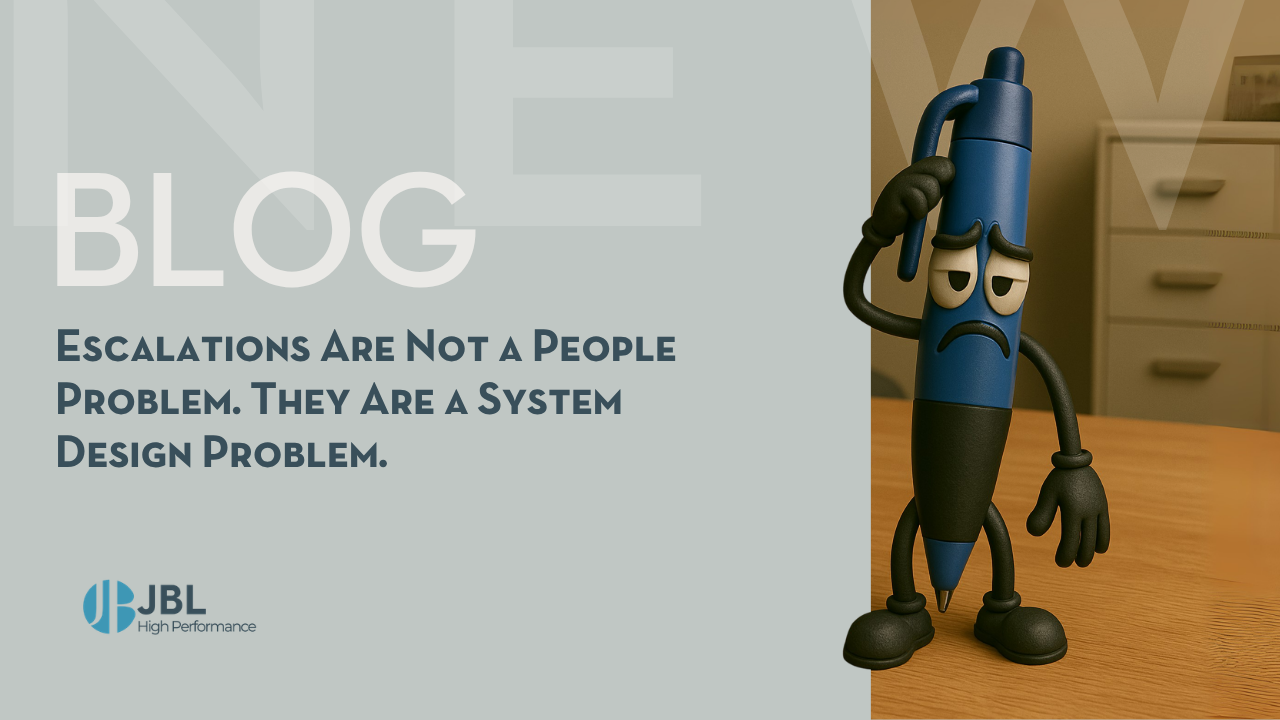
Too many escalations. Senior leaders dragged into decisions that should never reach them. Mid-level managers spending their days answering questions instead of leading. If this is your management layer right now, the instinct is to diagnose it as a confidence or accountability issue.
It is not. It is a system design problem. And the system is fixable faster than most organisations assume.
Why Escalations Keep Rising
Escalations rise when the system makes it quicker, safer, and more rewarding to ask than to decide. So people do what sensible people do. They escalate.
Three conditions drive this consistently:
- The cost of being wrong feels higher than the cost of waiting, so escalation becomes insurance.
- Decision rights are unclear, so the default is "I will check."
- At some point, leaders trained the organisation to escalate by responding fast, fixing quickly, and removing the pain.
Over time, people learn that the quickest route is through you.
That is not a character flaw. It is reinforcement.
What It Looks Like in Practice
Escalation cultures rarely look broken from the outside. They look helpful. They look responsive. They look like leaders being available.
In practice, you see:
- Senior people absorbed into small decisions.
- Mid-level leaders spending their capacity answering questions rather than driving delivery.
- Decisions made late because everything is queued behind one person.
If your best leaders are absorbing ambiguity for everyone else, escalations will keep rising until those leaders hit a wall or leave. That is an attrition risk and an execution risk in the same problem.
The Commercial Cost Most Organisations Underestimate
Escalations burn hours, fragment attention, and create decision bottlenecks. They also create learned helplessness in the layer below, because people stop building the muscle of judgement.
That is your pipeline problem. Your succession problem. Your organisational resilience problem.
Treat escalations like you would treat customer complaints or production defects. Not because people are broken, but because the system is giving you feedback. In our work, we typically see around 30% fewer escalations within the first six weeks once the system changes. The speed of that shift surprises most HR Directors.
Where is the friction in your team?
The Leadership Friction Finder pinpoints where effort is leaking, so you fix the cause rather than the symptom.
What Actually Reduces Escalations: the Organisational Level
There are two levels to fix this. You need both.
At the organisational level, you have to make it easier to decide than to ask.
Decision Clarity
People need to know the boundaries. What can be decided at team level? What needs consultation? What genuinely requires escalation? If you cannot articulate that clearly, you will receive escalations for everything.
Consequence Clarity
In healthy organisations, a wrong decision made with good judgement becomes learning. In unhealthy organisations, it becomes blame.
Escalations are entirely rational in a blame culture. No training programme fixes that without also changing the structural conditions.
What Actually Reduces Escalations: the Leader Behaviour Level
You also need to change the reward loop at the leader level.
If senior leaders respond instantly and solve everything, they remain the path of least resistance. The fix is not a lecture. It is a pattern change in how they respond to escalations.
When someone escalates, instead of solving it, ask:
- "What do you suggest?"
- "What options have you considered?"
- "What would you do if I was unavailable?"
This is not about being difficult. It is about returning the decision without abandoning the person. Done consistently, it rebuilds the judgement muscle in the layer below.
The principle: do not take ownership of a problem you did not create. Take responsibility for building the conditions where it gets solved at the right level.
Work on this with Jimmy directly
1:1 executive coaching gives you a thinking partner to turn these ideas into changed behaviour.
What to Watch for as It Improves
The first sign of progress is not silence. It is better quality escalations. Fewer of them, but higher value. Decisions that genuinely require senior altitude rather than decisions that require confidence.
Also watch for the rebound effect. When senior leaders stop rescuing, things can wobble briefly. That wobble is not failure. It is the organisation learning to stand on its own. If you step back in, you teach everyone that escalations still work.
The Strategic Question for Heads of OD
Escalations are a leading indicator of future leadership capability. Reduce escalations and you increase decision velocity. You also develop judgement in your mid-level layer.
If you are a CPO or Head of OD, escalations should be treated as a performance metric, not a behavioural annoyance. The data is already there. The question is whether you are using it to diagnose the system or to blame the individual.
Book a 20-minute conversation. https://jblhighperformance.com/coaching
We will review where escalation patterns are creating the most friction in your management layer and whether Six Week Reset or Amplify is the right fit to address it. No obligation. No sales pitch. Just a practical discussion.
When You Are Ready to Find Out More
- Tired of leadership advice that doesn’t work in the real world? Get practical insights that actually work
- Stuck in the leadership weeds and can’t see a way out? Book your 1:1 Strategic Breakthrough Session
- Burning out from leadership overwhelm? Get the antidote (my book)
Start this week
Busy all day and still behind?
The Quick-Win Pack is five five-minute fixes for the overloaded leader, each built on a framework I use with paying clients. Every fix runs live on the page and hands you a finished, ready-to-use plan in minutes, with no AI account of your own needed. Just $19, and included free with Amplify and the Six Week Reset.
Get the Quick-Win PackExplore this topic
Hear this discussed on the podcast
Episodes of The High Performance Leader that cover the same ground.

Jimmy Burroughes
FounderFormer British Army officer and corporate GM who has transformed 3,000+ managers into leaders across 30+ organisations. Creator of the Simplify to Amplify methodology, author of Beat Burnout, Ignite Performance, and two-time Global Recognition Award winner.
Keep exploring
Want to know where the drag really is?
Before you change anything, get an honest read on the friction slowing your team down. Take a short, free diagnostic and see exactly where the time is going.