How Back-to-Back Meetings Are Draining Your Team's Capacity
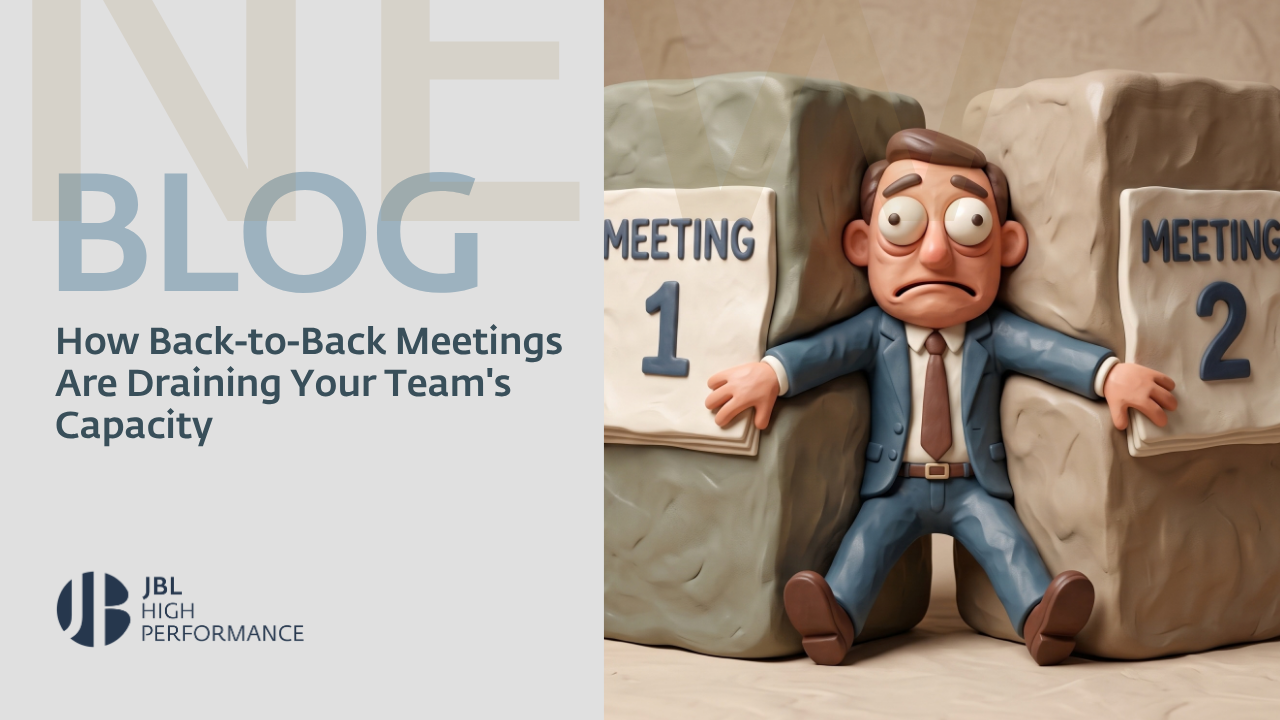
Look at your calendar this week.
You have pre-meetings to align before the main meeting, the actual meeting itself, post-meetings to discuss what really happened, and follow-up meetings to decide what you are going to do.
One decision. Four meetings.
And you wonder why you cannot get any real work done.
This is a glaring symptom of a deeper organisational disease: a fundamental lack of trust wrapped in a security blanket of consensus.
The Meeting Cycle That Signals Dysfunction
Think about your last major decision. How much time did you spend in pre-alignment conversations? "Let me just run this past you before the meeting." "Can we align on our position?" "I want to make sure we're on the same page."
Then the main meeting, where nothing happens because all the real conversations happened before.
Then the aftermath, with smaller groups huddling to interpret what was decided and what they are going to do about it.
If multiple meetings around decisions were valuable, the most efficient organisations would build them into their process. Instead, they hide in calendar shadows because everyone knows they signal dysfunction.
What each layer is telling you
- Pre-meetings reveal a fear of open dialogue
- Main meetings become theatrical performances
- Post-meetings expose a lack of true alignment
- Follow-up meetings demonstrate the absence of clear ownership
Your organisation has created a complex dance of avoidance, where every decision needs three layers of bubble wrap before it can be handled.
Think of it like preparing for a dinner party. You spend so much time discussing the menu, planning the seating, and worrying about everyone's preferences that you lose the joy and purpose of sharing a meal.
The Real Costs
- Time evaporates in redundant discussions
- Trust erodes as people learn the 'real' conversations happen elsewhere
- Decision-making becomes sluggish and complex
- Innovation dies in the quagmire of pre-alignment
- Ownership dissolves in the soup of collective responsibility
When people learn they need multiple meetings to make any decision, they stop taking ownership of decisions altogether.
Most of these meetings could be replaced by:
- A clear email
- A direct conversation
- Trusted owners making decisions
What Is Really Being Said
- "We need a pre-meeting" = "I don't trust open dialogue"
- "Let's align offline first" = "I'm afraid of honest disagreement"
- "Let's discuss this after" = "I won't say what I think in the room"
Are you the bottleneck?
Take the two-minute assessment and see exactly where work is queueing around you, and what to hand over first.
The Root Cause: Unclear Decision Rights
Meetings have become the workplace security blanket for avoiding decisions. Too scared to decide? Schedule a meeting. Worried about being wrong? Get group input. Want to avoid responsibility? Create a committee.
But the deeper problem is rarely a lack of courage. It is a lack of clarity about who can decide what. When decision rights are ambiguous, people default to consensus-seeking because it feels safer than being wrong alone. Your team learns to wait for group approval. Your strongest performers get frustrated because progress stalls behind a wall of calendar blocks. The organisation moves at the speed of its slowest meeting.
When decision rights are clear, meetings become choices, not crutches.
Getting clear on who owns which decisions, and how those decisions should be communicated, removes the structural reason most pre-meetings and post-meetings exist in the first place.
The Planning Problem That Makes It Worse
Even when meetings are genuinely necessary, most are planned badly. The typical invitation reads: "Weekly catch-up. 1 hour. Conference Room B." No purpose, no outcomes, no preparation required.
Leaders show up unprepared, unclear on why they are there, and hoping someone else will drive the conversation. They leave with vague action items and the sense they will need another meeting to decide anything. That is a planning failure, not a meeting failure.
Traditional planning asks "What will we talk about?" The question worth asking is "What will we achieve?"
The BRIEF framework
BRIEF is a planning approach that forces clarity before you waste anyone's time. It works across sectors. The bank managers who thought their meeting culture was "how banking works" and the construction leaders who believed constant site meetings were unavoidable both found the same thing: poor meetings are a leadership choice, not an industry requirement.
- B. Background and Purpose. Why does this meeting exist? What specific problem are we solving? If you cannot articulate that, you do not need a meeting. You need clarity.
- R. Results Needed. What does success look like when we leave? "Discuss the budget" is activity. "Decide on budget allocation with timeline agreed and next steps assigned" is a result.
- I. Individuals and Roles. Who needs to be there and why? If you cannot define someone's role and the outcome they will contribute to, they should not be in the room.
- E. Execution Plan. How will we move from current state to desired outcomes within the time available? This is a roadmap, not a list of topics.
- F. Follow-up Actions. Who owns what? When is the next checkpoint? The meeting does not end when people leave the room. It ends when the commitments are delivered.
When 250 managers from a major bank implemented this framework, meeting time reduced by 30% within the first month, decision-making speed increased by 14%, and follow-through on commitments improved by 65%. One department head calculated they saved 12 hours per week of pointless meetings across their team. The framework works because it forces the hard thinking before the meeting, not during it.
Where is the friction in your team?
The Leadership Friction Finder pinpoints where effort is leaking, so you fix the cause rather than the symptom.
How to Break the Cycle
Challenge the need for pre-meetings
Ask: "What are we afraid will happen if we discuss this openly in the main meeting?"
Make main meetings count
- Start with "What's not being said?"
- Welcome constructive conflict
- Make decisions in the room
- Assign clear owners
Kill the post-meetings
- Ensure decisions are clear before people leave
- Record specific actions and owners
- Make disagreement safe in the room so it does not migrate to the corridor
- Trust owners to execute
Raise the bar for what gets a meeting at all
- Delete every recurring meeting and reinstate only those that pass the BRIEF test
- Decline invitations where no clear decision outcome has been shared in advance
- Make decisions that are yours to make and communicate them directly rather than convening a group to ratify them
- Introduce meeting-free blocks so your team has time to do the work that meetings are supposed to enable
Your impact as a leader is not measured in meetings attended. It is measured in decisions made, actions taken, and results achieved.
Your Challenge
Next time someone suggests a pre-meeting, ask: "What if we had this conversation in the actual meeting where decisions can be made?"
When you sense post-meetings forming, say: "Let's discuss those concerns now, where we can address them."
And before you send your next meeting invitation, run it through BRIEF. If you cannot fill in the Background, Results and Individuals sections in two minutes, the meeting is not ready. Neither are you.
Organisational effectiveness is built on trust, clear ownership, and the courage to have real conversations in real time.
If this sounds like your week
Your managers are not the problem. They are where the problem is stuck.
When your last leadership spend was signed off, did anyone go back to those managers' bosses and ask what changed? That question is the JBL Outcome Standard, and it is how I work.
- Find the friction. A short diagnostic that shows which decisions are stalling, and at what level.
- Am I the bottleneck? Ten questions on where your week is actually going.
- How I work with GMs. Six weeks, one hour a week, up to twelve of your managers, scored by their own bosses.
- Beat Burnout, Boost Performance. The book.
- The High Performance Leader podcast.
Managers I work with reclaim around four hours a week, and their bosses score the change 8.75 out of 10. Would it be a crazy idea to find out how we did this? Book a scoping call.
From the YouTube channel
Watch: more on this topic
A video from the JBL High Performance YouTube channel that goes deeper on the ideas in this article.
The guaranteed way to improve ALL YOUR MEETINGS that ONLY takes 30 seconds
More on this from the channel
Start this week
Busy all day and still behind?
The Quick-Win Pack is five five-minute fixes for the overloaded leader, each built on a framework I use with paying clients. Every fix runs live on the page and hands you a finished, ready-to-use plan in minutes, with no AI account of your own needed. Just $19, and included free with AMPLIFY and the Six Week Reset.
Get the Quick-Win PackQuestions managers ask about this
Why do back-to-back meetings reduce team productivity?
Back-to-back meetings waste time on repetitive discussions and pre-alignment talks. This leaves little space for actual work, as energy is drained on preparing, repeating, and clarifying decisions rather than executing them. It signals a lack of trust and clear ownership, causing decision-making to slow and innovation to stall.
How can I make main meetings more effective for decision-making?
Start meetings by addressing unspoken issues and encourage open, constructive conflict. Make decisions during the meeting and assign clear owners for each action. Avoid pre-meetings by fostering honest dialogue in the main session, which builds trust and reduces unnecessary follow-up discussions.
What does frequent use of pre-meetings indicate about a team?
Pre-meetings often reveal a fear of open dialogue and honest disagreement within the team. They suggest people do not trust the main meeting to handle real conversations, which leads to fragmented communication and slows down decision-making processes.
How can organisations reduce the number of post-meetings?
Ensure decisions made in meetings are clear and well documented with specific actions and assigned owners. Make disagreement safe during the meeting so concerns are addressed immediately. Trust those owners to execute decisions without needing multiple follow-ups.
Explore this topic
Hear this discussed on the podcast
Episodes of The High Performance Leader that cover the same ground.

Jimmy Burroughes
FounderFormer British Army officer and corporate GM who has transformed nearly 3,500 managers into leaders across 30+ organisations. Creator of the Simplify to Amplify methodology, author of Beat Burnout, Ignite Performance, and two-time Global Recognition Award winner.
Keep exploring
Want to know where the drag really is?
Before you change anything, get an honest read on the friction slowing your team down. Take a short, free diagnostic and see exactly where the time is going.