How to Spot When Your Leaders Are Optimising for Headlines Not Results
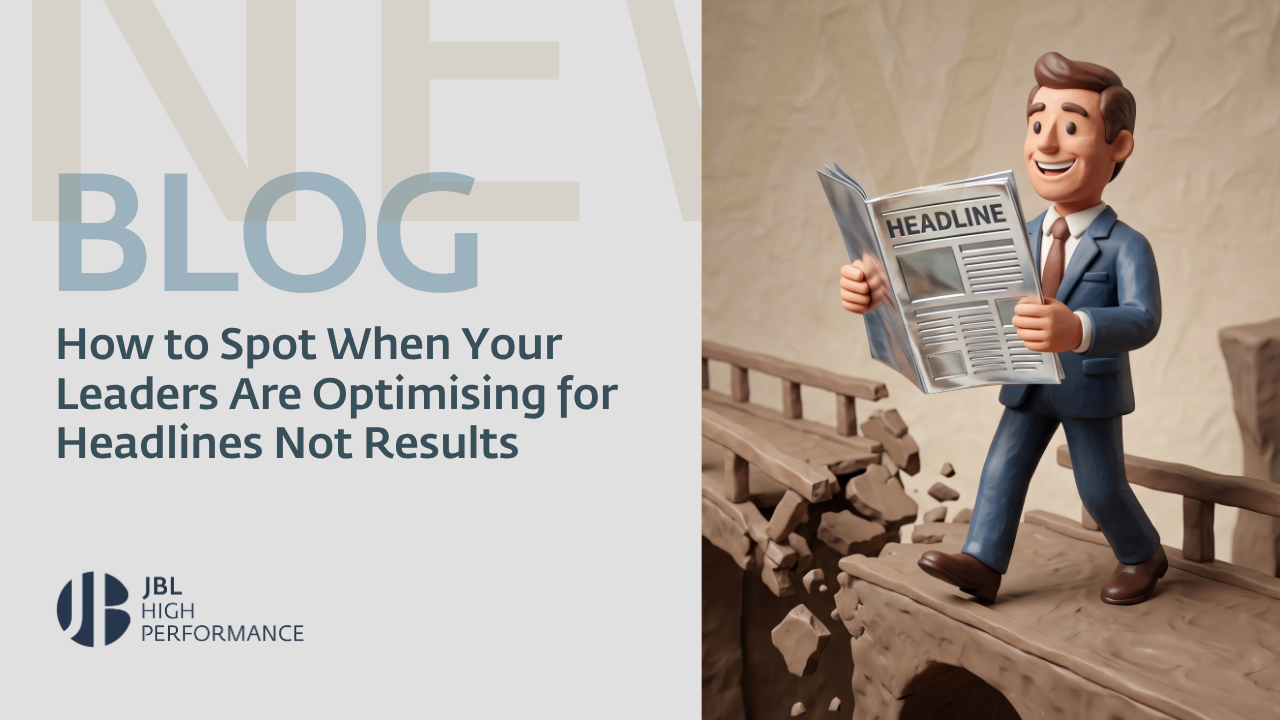
Walk into any leadership team meeting and you will see it: leaders who have mastered the art of looking busy while accomplishing little. Projects branded as "transformational" that transform nothing except PowerPoint templates. Metrics carefully curated to tell a story rather than reveal the truth.
Recent research shows that companies increasingly fail because they are "performing for each other instead of delivering for the business." When everything becomes theatre, nothing moves the needle.
The Seductive Pull of Performance Leadership
Why do smart leaders fall into this trap? Being noticed is intoxicating:
- You get applause in meetings
- You look impressive in presentations
- You generate internal buzz and recognition
- It is easier to measure than real impact
What This Style of Leadership Actually Costs
Your best people leave. High performers watch effort get rewarded over outcomes, and they walk. Driven people disengage when performance masquerades as progress.
Trust erodes. When teams see leaders optimising for visibility rather than value, they stop believing in the mission. They start protecting themselves instead of pursuing excellence.
Real problems go unsolved. While everyone is focused on the show, the unglamorous, difficult, necessary work gets neglected.
The most insidious symptom is how "being busy" became the ultimate credential. Leaders wear packed calendars like medals of honour. Meetings multiply to fill available time. Activity gets confused with achievement. Everyone complains about it, and yet when we challenge leaders to remove 20% of their meetings during the Amplify programme, some are initially resistant because they worry about being less busy. When they do it, they realise the real impact.
Being busy is not a strategy. It is often a sign that you have not figured out what actually matters.
Most of what fills a leader’s day has zero correlation with organisational success. Leaders spend 21.5 hours weekly in meetings, and 83% report being overwhelmed by tactical demands that add no strategic value.
What Our Type of Leadership Looks Like
While others perform, exceptional leaders focus on three things that move organisations forward:
1. Ruthless Priority Clarity
They set priorities and protect them. They say no to good opportunities that distract from great ones. They eliminate work that looks important but delivers little.
2. Systems Over Heroes
They build teams and organisations that do not need them involved at every step. They create processes, develop people, and establish frameworks that generate results without their constant intervention.
3. Outcome Obsession
Every initiative, every meeting, every decision gets filtered through one question: "Does this improve customer satisfaction, team performance, or business results?" If it does not clearly advance at least one without sacrificing another, it gets cut.
Leaders who stop optimising for visibility often become more visible, for the right reasons. Their teams perform better. Their results speak louder than their presentations. Their reputation builds on substance, not spectacle.
Are you the bottleneck?
Take the two-minute assessment and see exactly where work is queueing around you, and what to hand over first.
The Visibility Paradox
Research on visible leadership shows that the most trusted leaders are those who consistently deliver transparent information, make fair decisions, and follow through on commitments. They are not the ones who appear most often in company communications.
Breaking the Performance Cycle
If you recognise yourself in this pattern, here is how to shift from optics to outcomes:
- Audit your calendar ruthlessly. What percentage of your time actually moves the business forward, and what percentage makes you look busy?
- Change your success metrics. Stop measuring inputs (hours worked, meetings attended, initiatives launched) and start measuring outputs (problems solved, people developed, results delivered).
- Embrace strategic visibility. Some of the most important leadership work happens behind the scenes: developing people, removing obstacles, making tough decisions that others never see.
- Question every "transformation." Before launching the next big initiative, ask: "What specific problem does this solve, and how will we know it is working?"
You can optimise for headlines or for results. For applause or for achievement. For looking good or for doing good. You cannot do both.
What is your experience? Have you seen leaders in your organisation fall into the headline-chasing trap? How do you distinguish between necessary visibility and empty optics in your own leadership?
About the Author: Jimmy Burroughes transforms overwhelmed managers into strategic leaders through the Simplify to Amplify methodology. Through his Amplify Leadership programme, he helps leaders reclaim their time and maximise their impact.
If this sounds like your week
Your managers are not the problem. They are where the problem is stuck.
When your last leadership spend was signed off, did anyone go back to those managers' bosses and ask what changed? That question is the JBL Outcome Standard, and it is how I work.
- Find the friction. A short diagnostic that shows which decisions are stalling, and at what level.
- Am I the bottleneck? Ten questions on where your week is actually going.
- How I work with GMs. Six weeks, one hour a week, up to twelve of your managers, scored by their own bosses.
- Beat Burnout, Boost Performance. The book.
- The High Performance Leader podcast.
Managers I work with reclaim around four hours a week, and their bosses score the change 8.75 out of 10. Would it be a crazy idea to find out how we did this? Book a scoping call.
Start this week
Busy all day and still behind?
The Quick-Win Pack is five five-minute fixes for the overloaded leader, each built on a framework I use with paying clients. Every fix runs live on the page and hands you a finished, ready-to-use plan in minutes, with no AI account of your own needed. Just $19, and included free with AMPLIFY and the Six Week Reset.
Get the Quick-Win PackQuestions managers ask about this
How can I tell if my leaders focus on appearances not results?
Look for signs like busy calendars filled with meetings that add little value, projects labelled as transformational but with no real change, and metrics chosen to tell a flattering story rather than reveal truth. When leaders prioritise visibility over impact, performance stalls and trust declines.
What are practical steps to shift leadership focus from optics to outcomes?
Start by auditing leaders' calendars to identify time spent on real progress versus looking busy. Change success metrics to measure outputs like problems solved and results delivered, not just activity. Question every new initiative to ensure it solves a specific problem and has clear success indicators.
Why do some leaders prefer being visibly busy over delivering real results?
Being busy offers immediate recognition through applause, impressive presentations, and internal buzz. It’s easier to measure activity than impact, which can be intoxicating. However, this often leads to disengagement of high performers and neglect of critical but less glamorous work.
What qualities define leadership that truly drives organisational success?
Effective leaders set clear priorities and protect them, say no to distractions, and remove low-value work. They build systems and processes that reduce dependence on themselves. They focus obsessively on outcomes, ensuring every action improves customer satisfaction, team performance, or business results without compromise.
Explore this topic
Hear this discussed on the podcast
Episodes of The High Performance Leader that cover the same ground.

Jimmy Burroughes
FounderFormer British Army officer and corporate GM who has transformed nearly 3,500 managers into leaders across 30+ organisations. Creator of the Simplify to Amplify methodology, author of Beat Burnout, Ignite Performance, and two-time Global Recognition Award winner.
Keep exploring
Want to know where the drag really is?
Before you change anything, get an honest read on the friction slowing your team down. Take a short, free diagnostic and see exactly where the time is going.