Why Trying to Get Everything Done Is Making Things Worse
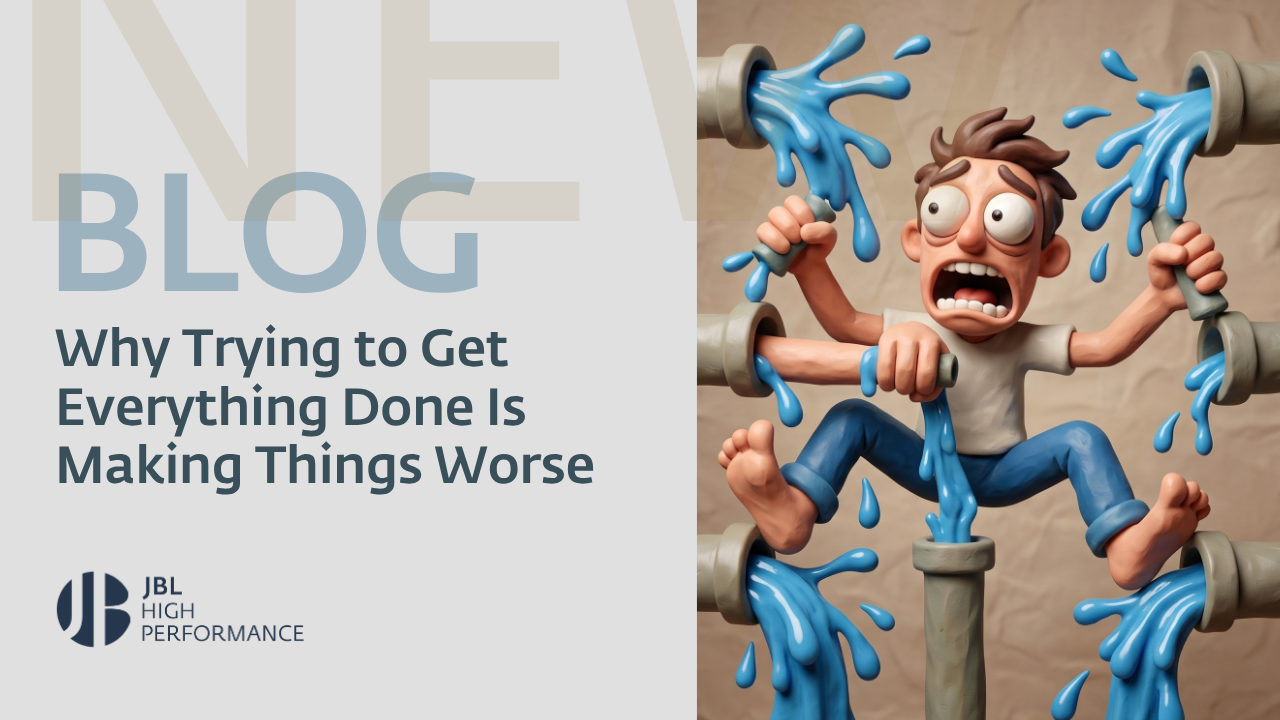
You are already behind, and the day has barely started.
Notifications stack up. Messages arrive faster than you can clear them. The list of things demanding your attention is longer than your working hours will ever allow.
Your stomach churns. Your shoulders tighten. That familiar knot of guilt sits in your chest.
You should be doing more. Handling more. Completing more.
Should you?
A Story That Changes Everything
A story I heard recently might change how you think about this.
I sat with an Amazon executive who receives over 2,000 emails daily. His team faces roughly 50 genuine crises every 24 hours, each one urgent, each one important, each one demanding immediate attention.
How many does he solve?
Three to five.
One of the most senior executives at one of the world's most successful companies deliberately leaves 90% of his crises unaddressed every single day. Amazon's stock price seems to be doing just fine.
The Dangerous Belief That You Must Handle Everything
The belief that you should handle everything is dangerous. It is like trying to catch every raindrop in a storm. The attempt itself becomes more destructive than the rain.
If handling everything were what made leaders successful, every successful leader would do it. The ones who perform best deliberately do less.
What nobody tells you about senior leadership: your value is not measured by the volume of tasks you complete. It is measured by the significance of the problems you choose to solve.
Quantity of completion is the wrong measure. Quality of impact is the right one.
Are you the bottleneck?
Take the two-minute assessment and see exactly where work is queueing around you, and what to hand over first.
An Honest Look at Your Last Week
Think about your last week:
- How many hours did you spend on low-impact tasks that felt urgent?
- How many strategic opportunities did you miss while drowning in details?
- How much mental energy did you waste feeling guilty about what was not done?
The most successful leaders I work with have learned something counterintuitive: their greatest impact often comes from what they choose not to do.
Every yes to a minor task is a no to a major opportunity.
The Shift Worth Making
Stop asking "How can I get everything done?" and start asking "What few things would create the most significant impact?"
A Practical Step for Tomorrow
- Look at your to-do list.
- Identify the three items that would create a genuine, lasting impact.
- Put your best energy there.
- Make peace with what remains undone.
Things will be left incomplete. Some people will be disappointed. It will feel uncomfortable.
That discomfort is what breaking free from the myth of total completion actually feels like.
If an Amazon executive can run effectively while addressing only 5% of daily crises, you can run your business without completing every item on your list.
Your job is to do what matters. The rest can rain.
Jimmy Burroughes transforms overwhelmed managers into strategic leaders. Through his Amplify Leadership programme, he helps leaders reclaim their time and maximise their impact.
If this sounds like your week
Your managers are not the problem. They are where the problem is stuck.
When your last leadership spend was signed off, did anyone go back to those managers' bosses and ask what changed? That question is the JBL Outcome Standard, and it is how I work.
- Find the friction. A short diagnostic that shows which decisions are stalling, and at what level.
- Am I the bottleneck? Ten questions on where your week is actually going.
- How I work with GMs. Six weeks, one hour a week, up to twelve of your managers, scored by their own bosses.
- Beat Burnout, Boost Performance. The book.
- The High Performance Leader podcast.
Managers I work with reclaim around four hours a week, and their bosses score the change 8.75 out of 10. Would it be a crazy idea to find out how we did this? Book a scoping call.
From the YouTube channel
Watch: more on this topic
A video from the JBL High Performance YouTube channel that goes deeper on the ideas in this article.
Stop Workload Overload - Live Q&A
Start this week
Busy all day and still behind?
The Quick-Win Pack is five five-minute fixes for the overloaded leader, each built on a framework I use with paying clients. Every fix runs live on the page and hands you a finished, ready-to-use plan in minutes, with no AI account of your own needed. Just $19, and included free with AMPLIFY and the Six Week Reset.
Get the Quick-Win PackQuestions managers ask about this
How can I stop feeling overwhelmed by my to-do list?
Focus on identifying the three tasks that will create the most significant impact and concentrate your energy there. Accept that some tasks will remain undone and that this discomfort is part of prioritising effectively. This shift reduces overwhelm and helps you work smarter, not harder.
Is it realistic to ignore some urgent tasks at work?
Yes, it is realistic and often necessary. Even senior leaders at major companies leave many urgent issues unaddressed each day. The key is to focus on the few problems that truly matter and have a lasting impact, rather than trying to solve everything immediately.
What should I prioritise as a general manager to improve team performance?
Prioritise tasks that create genuine, lasting impact rather than those that just feel urgent. This means choosing quality over quantity and focusing on strategic opportunities instead of low-impact details. Your role is to solve significant problems, which will improve overall team performance.
How do I know if I am the bottleneck in my team’s workflow?
Assess where decisions are stalling and at what level within your team. If many issues require your input and slow progress, you may be the bottleneck. Identifying this allows you to delegate better and focus on higher-impact tasks, freeing up your time and improving team efficiency.
Explore this topic
Hear this discussed on the podcast
Episodes of The High Performance Leader that cover the same ground.

Jimmy Burroughes
FounderFormer British Army officer and corporate GM who has transformed nearly 3,500 managers into leaders across 30+ organisations. Creator of the Simplify to Amplify methodology, author of Beat Burnout, Ignite Performance, and two-time Global Recognition Award winner.
Keep exploring
Want to know where the drag really is?
Before you change anything, get an honest read on the friction slowing your team down. Take a short, free diagnostic and see exactly where the time is going.